 Ozikoro
Historical Studies · Published history
Amai: A Ukwuani Community in the Ndokwa Hinterland
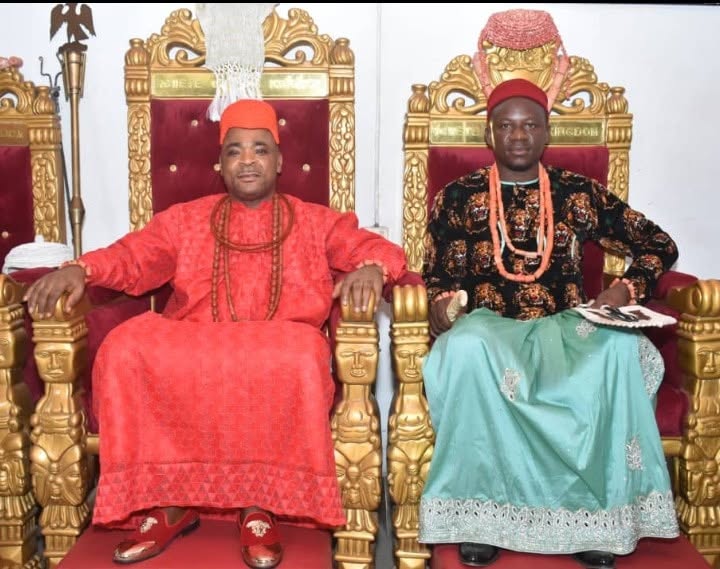
Amai is an Ukwuani-speaking community in Ndokwa land, Delta State, set in the hinterland of the Niger Delta. Obiaruku lies to the north, Ezhiokpor to the east, Aragba, Orogun and Umuebu to the west, and Ogume and Ezhionu to the south.
The written record
It is one of the historic Ukwuani communities, whose language, customs and social institutions belong to the wider Igbo cultural and linguistic continuum of the western Niger. Its story is one of Igbo-speaking peoples moving, settling and mixing across the Niger and into the Ndokwa hinterland.
Historical context
Where the People Came From
Amai traditions remember a long migration from the east and the north-western parts of the region before the ancestors of today’s community found their present home. One tradition recorded by the community traces them through Aboh, the important Igbo kingdom on the lower Niger, and then westward into the Ndokwa area. It places this movement several centuries ago, with Amai taking shape around the fifteenth century.
That tradition belongs to the wider history of Igbo and Ukwuani migration along the Niger. Aboh and the riverine towns around it were centres from which people spread into the neighbouring hinterlands, founding settlements that later became part of the Ukwuani cultural region. For this reason, Amai’s identity is better read through its Ukwuani-Igbo language and culture and its ties with neighbouring communities than through a single story of outside origin.
The Five Quarters
Amai is traditionally organised into five principal quarters, each tracing its ancestry to the community’s founding population:
- Amage-Amai
- Umueku
- Umubu
- Ishikaghuma
- Umuosele
The kingship is tied to these five quarters, and the office has historically rotated among them, which shows how central quarter and lineage organisation was to Ukwuani-Igbo political life. As in many Igbo communities, power was never held by the ruler alone. Lineages, elders, titled men and community assemblies all had a hand in managing communal affairs.
Amai in the Colonial Period
Amai became an important administrative centre under colonial rule. Local accounts say it was the first district headquarters of the Ndokwa area, serving surrounding communities including Kwale, Abbi, Ogume, Obiaruku, Umutu and Ebedei.
A key moment came on 22 October 1896, when the community concluded an agreement with the British colonial authorities. It was linked to the expedition led by Ralph F. Locke. The contemporary description presented Amai as a large, well-organised community with rich agricultural resources, including kolanut, coconut and oil-palm trees that were seen as having real commercial promise. The agreement drew Amai into the expanding British colonial sphere while recognising its authority over its own affairs and its relations with neighbours. It also shows that Amai was already an organised and economically significant settlement before colonial administration took hold in the region.
Farming and Local Trade
The traditional economy rested mainly on agriculture and local trade. The fertile land, wide farmland and rainforest supported both food crops and tree crops, and the abundance of oil palms and kolanut trees tied Amai to the wider commercial economy of the Niger Delta and western Igboland. Farming stayed central even as commercial and educational activity grew.
Culture and Religion
Amai’s cultural life forms part of the broader Ukwuani-Igbo tradition of Ndokwa land. Festivals, music, dance and communal celebrations remain important expressions of local identity, blending farming traditions, ancestral customs, religious observance and inherited social institutions.
Like many Ukwuani-Igbo communities, Amai historically practised traditional religion centred on the bond between the community, its ancestors and the spiritual forces of the land. Christianity is now the dominant faith, though elements of indigenous practice survive as part of the cultural heritage. Amai also has a Muslim population and has been described as an important centre of Islam in Ndokwa land, which gives it a religious diversity unusual for the region.
The Modern Period
For much of its modern history Amai stayed largely rural, but the founding of Novena University in the community changed that considerably. The university brought population growth, along with students, academics, professionals and businesses, and Amai began to shift from a mainly farming settlement into a more varied, urbanising centre. Education has encouraged new enterprises too, among them accommodation, information and communication services, retail and other businesses serving the growing population.
Local accounts also point to further opportunities in mechanised agriculture and in using the area’s clay for ceramics, and the university has increased demand for accommodation, hospitality and retail. Together, farming, education, local trade and new business have widened the community’s economic base.
Amai in the Ukwuani-Igbo World
Amai is best understood as part of the wider Ukwuani-Igbo civilisation of the western Niger. Its history reflects the same processes that shaped many communities across Ndokwa and the lower Niger: migration, settlement, contact between riverine and inland peoples, agricultural expansion, trade and the rise of autonomous communities. Its links with Aboh and other Niger communities are especially useful for understanding these movements, because the Niger was not merely a boundary but a route along which people, goods, ideas and institutions travelled.
Amai Today
Today Amai pairs its traditional farming character with a growing urban and educational setting. Its green landscape, wide farmland, cultural traditions and rising population still shape its identity. From its five-quarter structure and agricultural economy to its colonial-era importance and its university community, Amai has changed a great deal while remaining an important Ukwuani-Igbo community of Ndokwa land.
Sources and references
- Ndokwa Reporters. (n.d.). Amai: Land of good news . Ndokwa Reporters.
Cite this article
Discussion
Sign in to join the discussion
Comments are checked by an editor before they appear. Leave a source or a correction and it is read first.
Continue reading


No comments yet
Nothing has been approved on this record yet. Comments are checked by an editor before they appear, so one written now shows on this page after that check.