 Ozikoro
 Historical Studies · Published history
Beyond Wrestling: Sport in Pre-colonial West Africa
If one is to think of sporting activities as it pertains to pre-colonial West Africa, most of the time, one is going to think of wrestling, which is some sort of cliché sport. While wrestling seems to have been the predominant sporting activity in West Africa in the pre-colonial era, the historical actors inhabiting the region engaged in different sporting activities outside of wrestling for their amusement. They engaged in sporting activities that required equestrian dexterity, mastery of the Atlantic currents, and also cerebral acuity.
The written record
Wrestling at Elele described by P. A. Talbot as wrestling to make the yams grow. Chief Eleche’s place, Elele in Some Nigerian Fertility Cults, 1927In the late 1500s, the Cape Verdean writer, trader and adventurer, André Álvares de Almada, while praising the horse-riding adeptness of the Wolofs of the Senegambia, made note of the fact that they also engaged in equestrian duelling (Joust). He noted that “they frequently challenge each other and hold jousts in which they make bets on the one who can cut the strap from his opponent’s saddle, using the large spear they call assa, without injuring his opponent or killing his horse. If one of them does wound or kill he pays compensation and loses the game.” [1]
On the Gold Coast of West Africa, the inhabitants of this area, one of the best and most skilful swimmers in the world in the early modern era, engaged in the aquatic water sport of surfing. As Kevin Dawson in “Undercurrents of Power: Aquatic Culture in the African Diaspora” points out, “Michael Hemmersam, who was a superficial observer, provided the first known account of African surfing. Believing he was watching Gold Coast children learn to swim, he wrote that parents “tie their children to boards and throw them into the water.” Barbot penned the next known account in 1679, noting that children at Elmina learned “to swim, on bits of boards, or small bundles of rushes, fasten’d under their stomachs, which is a good diversion to the spectators… In 1834, while at Accra, James Alexander wrote: “From the beach, meanwhile, might be seen boys swimming into the sea, with light boards under their stomachs. They waited for a surf, and came rolling like a cloud on top of it.” [2]
John Adams in the late 1700s, also made note of the aquatic water sport activity of surfing on the Gold Coast, pointing out that it brought out plaudits of spectators. While writing about the Fante people of the Gold Coast, he noted that their “Children amuse themselves by a game similar to our hunting the slipper; and those residing in the villages near the sea shore, obtain pieces of broken canoes, which they launch, and paddle outside of the surf, when, watching a proper opportunity, they place their frail barks on the tops of high waves, which, in their progress to the shore, carry them along with great velocity; and the principal art of these young canoe-men consists in preserving their seats while thus hurried along, and which they can only do by steering the planks with such precision, as to prevent them broaching to; for when that occurs, they are washed off, and have to swim to regain them, while their more dexterous companions reach the shore amidst the plaudits of the spectators, who are assembled on the beach to witness their dexterity.” [3]
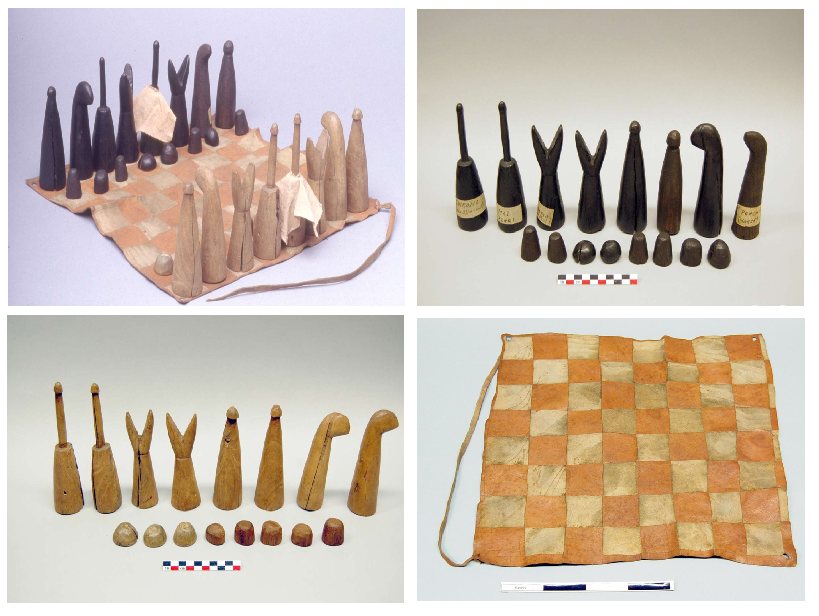
In Birni Ngazargamu (1484-1808), the capital of Sayfawa Bornu in the early modern era, as the Fezzani Shereef Imhammed in the 1700s points out, for the amusement of Birni Ngazargamu’s patricians, they “are devoted to the more difficult and more interesting game of chess, in which they are eminently skilled.” [4]
Fig.1. A Bornu chess set and leather chessboard in the British Museum. It was acquired by a British anthropologist (circa 1912 – 1926). Credit: British Museum
Chess in Bornu was known as Tsatsarandi. It was played in a slightly different way compared to the Western/international game of chess. As noted by a British official in the early 1900s, “as regards the Bornu game of Chess (Tsatsarandi) I should like to make it quite clear that the moves of the pieces are not identical with our way of playing the game. The moves of some pieces correspond, but others do not…The King (Mai) the Knight (Fer), and the Castle (Kaigamma) move exactly the same as in our game. The Queen (Chiroma) can only move one square at a time and so moves like a King, except that its movement is even more restricted as it may move diagonally only. It has therefore the choice of only four squares for any one move and so, having to remain perpetually on its own colour, cannot threaten the opposing Queen. The Bishop (Bintu), like our own piece, moves diagonally only, remaining on its own colour; but even when placed on the centre of an unoccupied board, it has only four possible moves and they are the four diagonal squares next but one to itself. If another piece is situated on one of the diagonal squares adjacent to it, the Bishop may ‘jump’ that piece to reach the next square. The first move in a game, therefore, might be King’s Bishop to R.3 or Q.3..Pawns (Gollo) move as in our game except that the initial double-move is unknown. Castling is not played, nor is the ‘ pawn-en-passant’ move. All the details of mating, discovered checks, etc., are the same as played in our game.” [5]
From an information received by another British official in the area who had actually played the Bornu game of chess (Tsatsarandi) with “Abba Bukar”, a relative of the Shehu of Bornu, one of the few men in Bornu in the early 1900s who could still play the game, it was noted that, “the Pawn in its initial move can move either one, two or three squares. This is not in accordance with Mr Betts, who states that the initial double move of the pawn is unknown. In other respects, the pawns move as in our game, except that when the pawn reaches the eighth rank it cannot be promoted to a Queen, Rook, Bishop, or Knight, as in our game…Castling is not played, nor is the pawn-en-passant move. All the details of mating and discovered checks, &c, are the same as in our game. To inform an opponent that he is in check, the player hisses like the proverbial snake.” [6]
Moreover, in Bornu in the pre-colonial era, the historical actors of this polity also engaged in the equestrian sport of horse racing. In the autobiography of Nicolas Said (Mohammed Ali ben Sa’id) (a native of Bornu who lived in Africa, Asia, Europe, the Caribbean and America, and fought for the Union Army during the American Civil War), he noted that “the principal amusement of people in my country (Bornu) is wrestling, horse-racing, and dancing.” [7]
In the Kingdom of Oyo, there was a sporting activity of archery, which the individuals of this polity engaged in to amuse themselves. Richard Lander, on his second visit to Oyo-Ile in 1826, during the time of its wane, noted that people of Oyo “amuse themselves daily by attempting to discharge arrows through a small hole made for the purpose in a wall, at a great distance from the standing ground, and I have frequently seen individuals accomplish this difficult task three successive times … from a distance of up to one hundred yards…. it requires great and unceasing practice to attain to so much perfection.” [8]
Historical context
Notes/References:
- [1] A brief treatise on the rivers of Guinea (1594) by André Álvares de Almada. P. 12 From chapter 1 “Which discusses the Jalofo blacks, who are the first (to be met in Guinea) and the nearest to us; and their customs and laws”.
- [2] Dawson, K., 2018. Undercurrents of power: Aquatic culture in the African diaspora. University of Pennsylvania Press. pages 29-30.
- [3] Remarks on the Country extending from Cape Palmas to the River Congo by John Adams. Published in 1823. Pages 42-43.
- [4] Account of Bornu related by The Shereef IMHAMMED a 1700s Fezzani who used to trade in West Africa & had visited Bornu & its capital city. Found in “Proceedings of the Association for Promoting the Discovery of the Interior parts of Africa” published in 1790. page 154.
- [5] Harris, P.G., 1939. 32. Chess in Bornu: Nigeria. Man, pp.31-32.
- [6] Harris, P.G., 1939. 32. Chess in Bornu: Nigeria. Man, p. 31.
- [7] Said, N., 2014. The autobiography of nicholas said. Jazzybee Verlag.
- [8] Akintoye, Stephen Adebanji. A history of the Yoruba people. Amalion, 2010. Page. 253.
Sources and references
- [1] A brief treatise on the rivers of Guinea (1594) by André Álvares de Almada. P. 12 From chapter 1 “Which discusses the Jalofo blacks, who are the first (to be met in Guinea) and the nearest to us; and their customs and laws”.
- [2] Dawson, K., 2018. Undercurrents of power: Aquatic culture in the African diaspora. University of Pennsylvania Press. pages 29-30.
- [3] Remarks on the Country extending from Cape Palmas to the River Congo by John Adams. Published in 1823. Pages 42-43.
- [4] Account of Bornu related by The Shereef IMHAMMED a 1700s Fezzani who used to trade in West Africa & had visited Bornu & its capital city. Found in “Proceedings of the Association for Promoting the Discovery of the Interior parts of Africa” published in 1790. page 154.
- [5] Harris, P.G., 1939. 32. Chess in Bornu: Nigeria. Man , pp.31-32.
- [6] Harris, P.G., 1939. 32. Chess in Bornu: Nigeria. Man , p. 31.
- [7] Said, N., 2014. The autobiography of nicholas said . Jazzybee Verlag.
- [8] Akintoye, Stephen Adebanji. A history of the Yoruba people . Amalion, 2010. Page. 253.
Cite this article
Discussion
Sign in to join the discussion
Comments are checked by an editor before they appear. Leave a source or a correction and it is read first.
Continue reading


No comments yet
Nothing has been approved on this record yet. Comments are checked by an editor before they appear, so one written now shows on this page after that check.