 Ozikoro
Historical Studies · Published history
The Man Who Starved for Freedom: The Story of Sunny Okafor in Japan
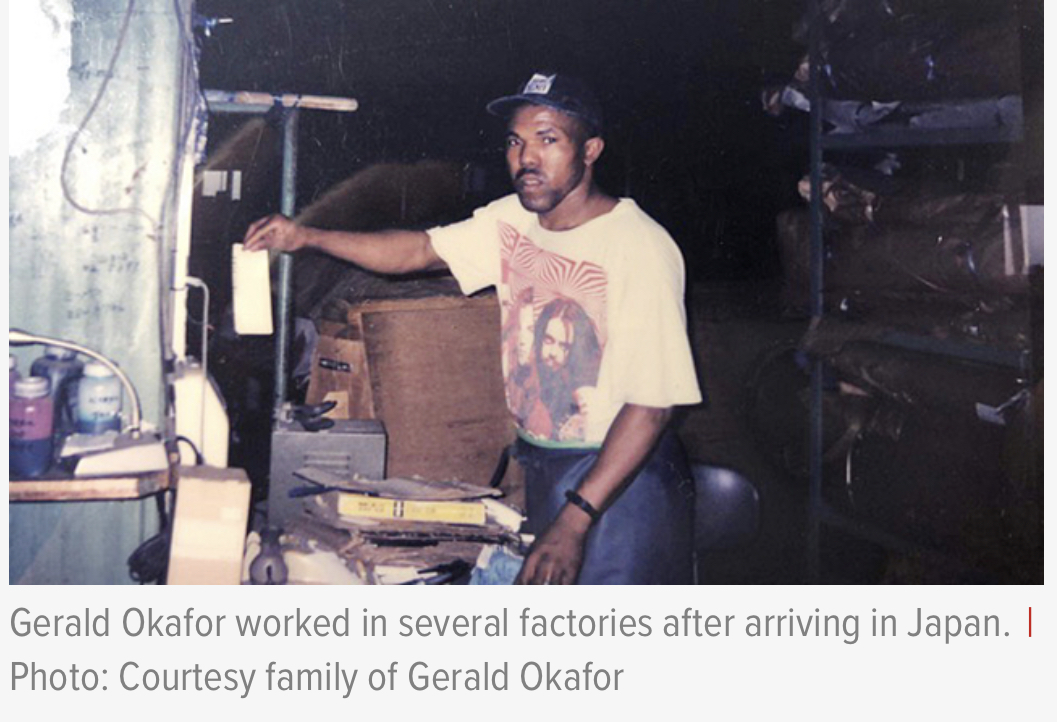
The Igbo say, “Afọ anaghị egbu onye, obi ka egbu ya” (it is not hunger that kills a man, but the heaviness of his heart). And somewhere in Nagasaki, Japan, in 2019, a man named Gerald “Sunny” Okafor died with an empty stomach but a full heart because he refused to swallow humiliation.
The written record
He was an Igbo man from southeastern Nigeria, the kind who left home with a promise: to find work, send money, and return one day with pride. Nineteen years earlier, he had travelled to Japan to work in the leather tanneries of Hyōgo Prefecture. Life was hard, but steady. Then came detainment, silence, and a system that forgot he was human.
His hunger strike lasted four weeks. The Japanese authorities said he “refused to cooperate.” But those who knew his story said otherwise; he was begging to be sent home.
Historical context
An Igbo Man Abroad
For the Igbo, migration is not escape; it is an exploration. “Ọ bụ njem ka eji ama onye,” (they say a person is known by his journey). Sunny’s journey began in hope and ended in headlines that never said his name. He was detained for immigration violations, a common fate for Africans in Japan’s rigid system. But what followed was crueller than imprisonment; erasure. When he died, the Japanese Ministry of Justice’s report did not even identify him. To the media, he was only “a Nigerian detainee.”
In truth, he was a husband and father. His wife, a deaf woman, struggled to raise their child alone after his detention. Immigration officials took advantage of her vulnerability, pressuring her to sign divorce papers. They promised it would hasten his release. It was a lie. When Sunny learned that he had been deceived, that he would not be released or deported, he refused intravenous fluids. It was his last act of defiance in a world that had already silenced his voice.
Silence as a Second Death
Japan’s Ministry of Foreign Affairs (MoFA) watched helplessly as the more powerful Ministry of Justice cleared the detention center of wrongdoing. Diplomats, embarrassed by the case, could only whisper their disapproval.
One official remarked bitterly: “May comes after January.” It was his way of saying the report made no sense, the same government that claimed Sunny refused deportation in January also documented that he begged to be sent home in May.
But Japan’s media printed the government’s version without question. There were no investigations, no corrections, no interviews with his family.
A man had died for freedom, and the world responded with silence. As Sunny’s widow later said, “They got the answers they needed from no one, from nowhere.”
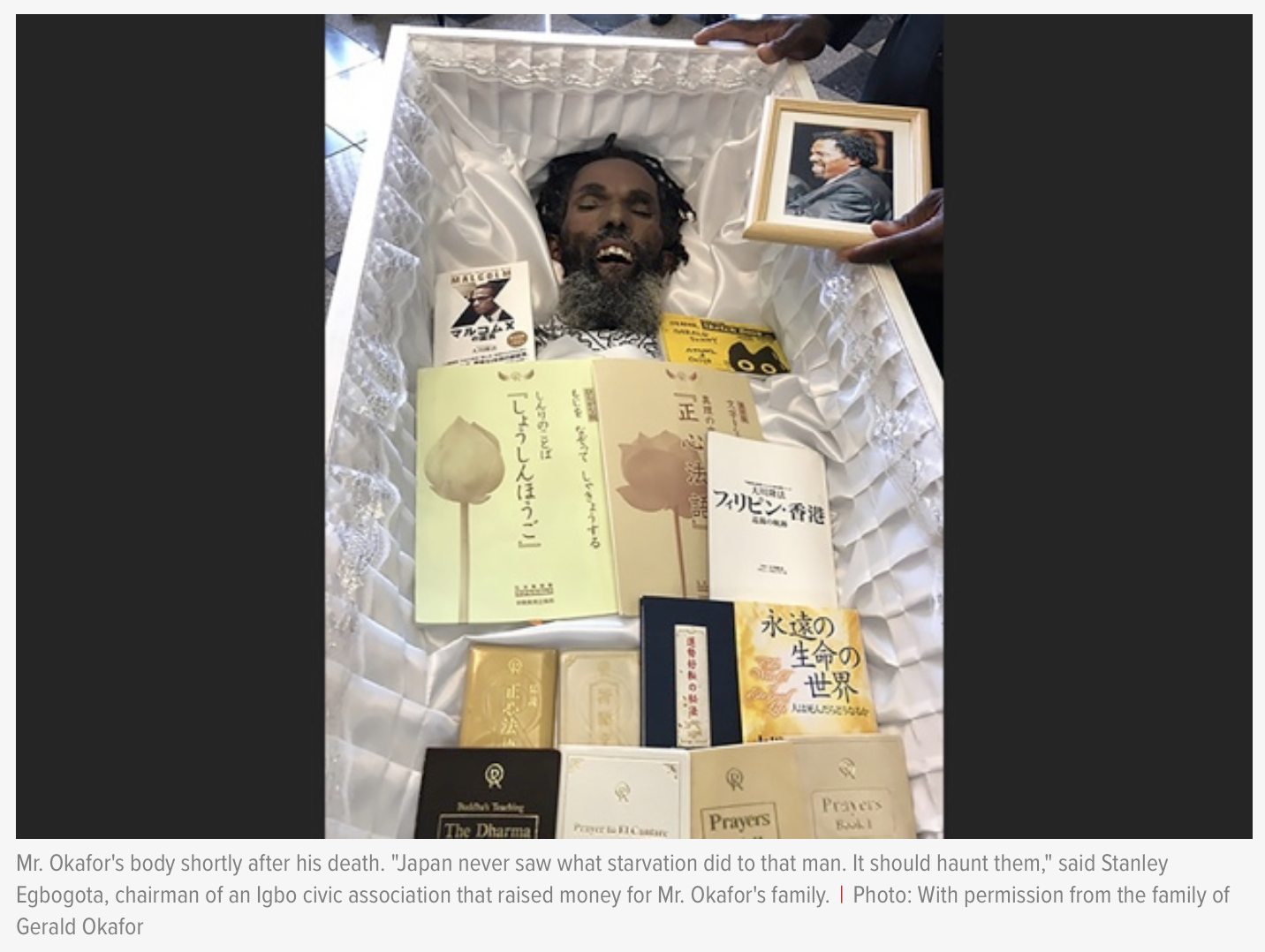
The Hunger That Speaks
Hunger has meaning in Igbo thought. It is not only about food, it is the yearning for justice, identity, and belonging. When Sunny starved himself, he was not trying to die. He was trying to be seen. He had been invisible for too long, to Japan’s bureaucracy, to the Nigerian embassy that helped cover up his file, and to the press that moved on too quickly. His body became his last voice, his hunger a form of testimony.
In traditional Igbo culture, when a person suffers injustice, the elders gather under the ụkwa tree to demand truth. But Sunny’s truth was buried under reports and procedures. Still, his death was not meaningless. It became a quiet prophecy about the cost of being foreign and Black in a nation that thrives on invisibility.
A Widow’s Echo
Sunny’s wife, unnamed in the press, faceless in policy, is the heart of this story. Deaf but determined, she tried to keep her family alive while the world turned away. She represents every immigrant’s family who waits for news that never comes, every woman who loses not only her husband but the story of his life.
Her struggle reminds us that exile is not always about geography, sometimes it is about being unheard. The Igbo say, “Anaghị egbu anụ, were isi ya gbaa egwu” (one does not kill an animal and then dance with its head). That is what the bureaucracies did; used his death as justification for more control, more coercion.
Japan’s government proposed reforms to give detention centers more power, arguing they could have “saved” him if they could force compliance. But the truth is simpler and sadder: they could have saved him by listening.
A Death Remembered
For six years, journalist Dreux Richard covered Japan’s Nigerian community. His book, Every Human Intention: Japan in the New Century (2021), documented lives like Sunny’s, men and women who became shadows in the machinery of a system that prized order over empathy.
His reporting revealed that Sunny Okafor’s story was never about immigration alone. It was about human worth. In Igbo cosmology, every life has chi; a personal spirit, a divine fragment of God. To deny a man dignity is to insult his chi. Sunny’s hunger strike was a confrontation between the powerless and the unseeing, between a man’s chi and an empire of silence.
He may have died in a Nagasaki detention cell, but his story lives as a whisper carried across oceans, from Hyōgo’s factories to Enugu’s red soil.
What His Story Teaches Us
For the Igbo, death is not an ending but a return. “Ọnwụ adịghị egbu mmadụ, obi mmadụ ka egbu ya,” (they remind us death does not destroy a person; what destroys him is being forgotten). Sunny Okafor’s story is a reminder of how easy it is to erase a man twice: first in life, then in memory.
But it is also a reminder of resilience, of how even silence can hold the weight of protest.
If freedom has a sound, perhaps it is the echo of a man refusing food because he will not swallow lies. And if remembrance has a face, perhaps it is his widow, sitting in her small Tokyo apartment, raising their child with the quiet dignity of one who has suffered and still believes in truth.
Sources and references
- Richard, D. (2021). Every Human Intention: Japan in the New Century. Pantheon Books.
- Richard, D. (2023, March 5). The death Japan forgot: The story of Gerald “Sunny” Okafor. Japan Today.
Cite this article
Discussion
Sign in to join the discussion
Comments are checked by an editor before they appear. Leave a source or a correction and it is read first.
Continue reading


No comments yet
Nothing has been approved on this record yet. Comments are checked by an editor before they appear, so one written now shows on this page after that check.