 Ozikoro
Historical Studies · Published history
When Gunshots Speak: The Traditional Communication System of Igbo Communities
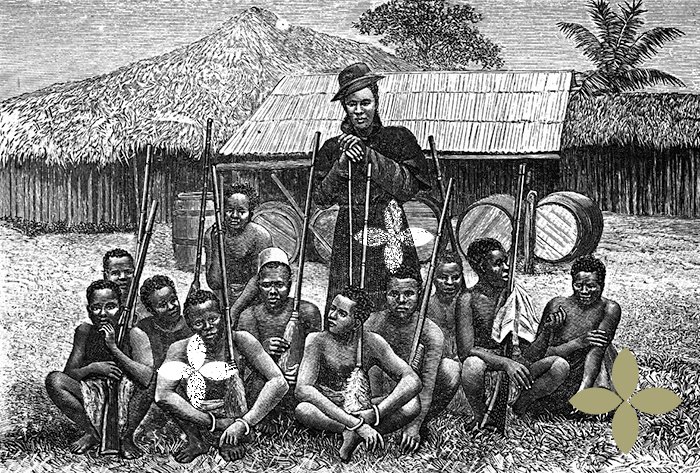
The sound of gunfire has long had a distinctive place in the history of the Lower Niger and the societies surrounding it. What eventually became a feature of ceremonies, funerals and public announcements in parts of Igboland was connected to a much wider history of European trade, firearms and coastal diplomacy.
The written record
European slave traders and merchants used gun salutes when receiving or honouring important African trading partners, high-ranking leaders and kings who visited or boarded their ships. In the Niger Delta and neighbouring coastal societies, these displays of gunfire became part of the ceremonial language surrounding diplomacy, trade and political status. Over time, such practices were appropriated and adapted by local societies, eventually finding their way into communities farther inland, including parts of Igboland.
The circulation of firearms itself also helped to facilitate this process. European traders, including Danes and Norwegians, imported firearms into the region, including flintlock muskets and guns assembled from various parts. As firearms became increasingly available, local blacksmiths in the Igbo hinterland began producing and repairing guns themselves, sometimes incorporating European-made components into locally manufactured weapons.
The gun therefore became more than a weapon. It could acquire social, political and ceremonial meanings within the communities that adopted it.
Historical context
When Gunshots Speak
In many Igbo communities, the sound of a gunshot has traditionally carried a meaning far beyond the firing of a weapon. Before modern communication systems became widespread in rural areas, distinctive sounds—including gunshots and petards—could serve as a form of public communication, conveying messages about important events, summoning people, or announcing occasions of communal significance.
The meaning attached to a gunshot depended largely on its number, timing and context. People who heard the sound were expected to understand that it was communicating something.
The King’s Summoning Voice
One example is olu ọ̀kụ̀ eze, literally the “king’s summoning voice”. In some Igbo traditions, four gunshots could function as a formal summons or announcement associated with the traditional ruler.
The practice has sometimes been compared with the modern idea of a gun salute. However, its traditional function was not simply ceremonial. The shots could communicate that something important was taking place and that people were expected to pay attention or assemble.
The number four was therefore not merely a matter of spectacle. In the context in which the custom was practised, the sequence itself carried information.
Calling the Community Together
Guns and petards, known in Igbo as nkpọ n’ala, could also be used to summon able-bodied members of a community.
A series of shots could indicate that something requiring collective attention had occurred. Depending on the community and circumstances, the sound might be associated with an emergency, a public announcement, a traditional ceremony, a significant visitor, or the death and burial of an important member of the community.
In societies where settlements could be spread across considerable distances, sound provided an effective way of reaching people without the need for a messenger to travel from household to household.
This meant that people developed an awareness of the sounds used around them. Hearing a particular sequence of gunshots or the distinctive explosion of a petard could immediately prompt questions: What has happened? Where is everyone being called to? Is there an emergency, a ceremony or an important announcement?
Gunshots at the Burial of Distinguished Elders
The practice was particularly significant during the burial of high-ranking elders and other important members of the community.
Dane guns and petards could be discharged a prescribed number of times as part of the funeral proceedings. In some communities, the number of shots could correspond to the sections or divisions of the community, giving the sound an additional social meaning.
Such displays were therefore not merely expressions of grief. They could also publicly communicate the status of the deceased and announce the gathering of the community.
The sound of gunfire could travel far beyond the immediate site of a burial, ensuring that people in surrounding areas were aware that an important event was taking place.
A Language of Sound
What makes this tradition particularly interesting is that it demonstrates how communication in traditional Igbo society did not depend exclusively on spoken words.
There were multiple ways of transmitting information across a community: human messengers, drums, horns, bells, visual signals and other forms of public announcement. Gunshots and petards became another part of this wider communication system.
The system was not necessarily uniform across Igboland. The number of shots and their meanings could vary from one community to another and according to the situation. A sequence that had one recognised meaning in one locality could have a different significance elsewhere.
Consequently, there was no single universal “Igbo gunshot code”. Rather, individual communities possessed their own conventions and understood the sounds according to local custom.
From Foreign Technology to Local Tradition
The history of the gun in Igbo society therefore illustrates how an imported technology could acquire meanings that went far beyond its original use.
European traders introduced firearms into the wider Niger region as part of a complex system of commerce, warfare and diplomacy. African societies did not simply receive these objects passively. Guns were traded, repaired, modified and eventually manufactured locally, while the customs surrounding their use were adapted to local political and social institutions.
A practice associated with European maritime diplomacy could consequently be transformed into something embedded in local tradition.
The gunshot became part of the vocabulary of authority, celebration, mourning and communal mobilisation.
More Than Noise
This tradition also reveals something important about the organisation of traditional Igbo communities.
A community did not necessarily need a centralised communication infrastructure to mobilise large numbers of people. A recognised sound could travel across a settlement and immediately attract attention.
The gunshot therefore became a kind of audible public notice.
Four shots could be understood as a summons. A different number or sequence could communicate another message. Petards could signal an emergency, celebration or important public occasion. At funerals, repeated shots could honour the deceased and simultaneously alert the wider community.
The meaning was created by custom and collective understanding.
The Changing Meaning of the Gunshot
With the expansion of modern communication—telephones, radio, motor transport and social media—the practical necessity of these traditional signalling systems has diminished. Yet the cultural meaning of ceremonial gunfire has survived in many places.
Today, gunshots during traditional ceremonies may be interpreted primarily as expressions of honour, celebration or status. But beneath the spectacle lies an older system in which sound itself could communicate information.
The important point is that these traditions should not be understood simply as people “shooting guns during ceremonies”. In their original social context, the sound could function as a message.
The traditional Igbo community had developed ways of making a landscape communicate. A gunshot in the distance could make people stop what they were doing and listen. Its meaning depended on the number of shots, the occasion, the community and the people who heard it.
In that sense, olu ọ̀kụ̀ eze, the king’s summoning voice, was not merely the sound of a gun. It was the sound of authority calling a community to attention.
Cite this article
Discussion
Sign in to join the discussion
Comments are checked by an editor before they appear. Leave a source or a correction and it is read first.
Continue reading


No comments yet
Nothing has been approved on this record yet. Comments are checked by an editor before they appear, so one written now shows on this page after that check.