 Ozikoro
Cultural Heritage · Published history
Between Faith and Heritage: The Catholic Priest Protecting Igbo Traditional Artifacts
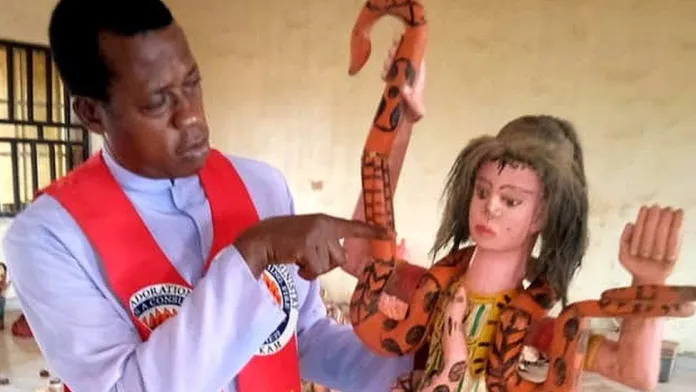
The Igbo say, “Ọnụ anaghị atụ egwu, ọ na-agwa mmadụ eziokwu”( the mouth that tells the truth does not tremble). And in Nsukka, one man dares to tell the truth about a forgotten part of Igbo identity, the truth hidden behind wooden masks, dust, and silence. Father Paul Obayi, a Catholic priest and exorcist, walks daily through rooms filled with carvings of deities, ancient masks, and sacred drums. These are not relics of idolatry to him, but stories frozen in wood. They whisper about who the Igbo once were before the arrival of missionaries and colonial priests.
The written record
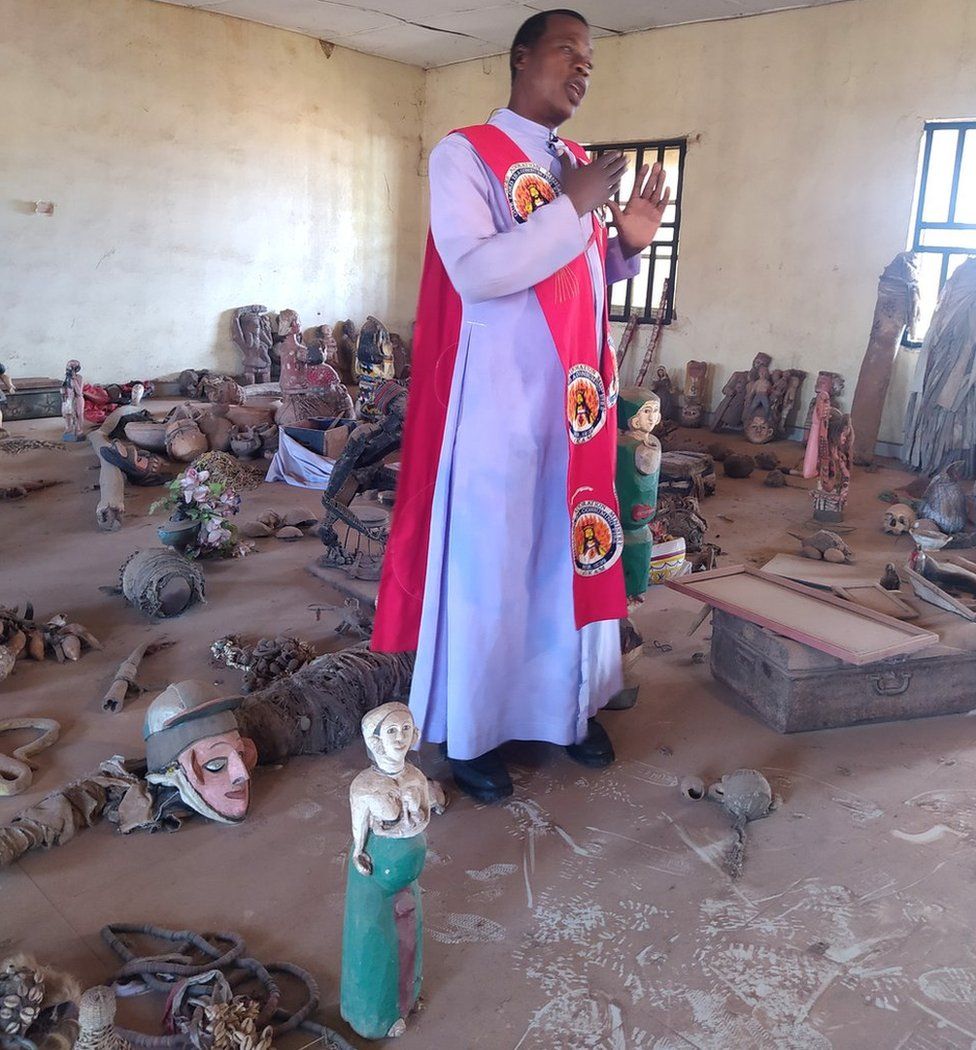
He calls this place the Deities Museum, a small, dimly lit space within the compound of St. Theresa’s Catholic Cathedral, Nsukka. Inside are hundreds of sacred totems, carved faces, ritual drums, and even a stuffed lion, all rescued from fire pits, shrines, and rivers where they were once thrown as “evil things.” To many Pentecostal preachers, these are symbols of darkness. But to Father Obayi, they are artifacts of light, the kind that shines through the cracks of cultural misunderstanding.
The Conflict Between Faith and Heritage
Long before Christianity, the Igbo lived by Ọdịnala; the sacred order that governed their world. Every hill, river, and grove held the spirit of Chukwu’s creation. People prayed to deities such as Ani, Amadioha, or Ikenga, not as gods apart from the Almighty, but as channels to the divine. Then came the missionaries, with crosses in hand and fear in their voices. They called the deities “idols,” and the shrines “abominations.”
For generations, the Igbo were taught to burn their own past. Families buried their ancestral masks. Some even sold them to strangers who shipped them overseas to European museums. What was left behind was not just wood or clay, but a hole in the collective memory of a people. Father Obayi remembers villagers bringing him carved figures for exorcism. “They believed these items caused their misfortunes,” he told Catholic News Service (2023). “But after the rituals, I realized these were more than idols, they were history.”
Historical context
How the Priest Became a Curator of Memory
Appointed by Bishop Godfrey Igwebuike Onah as the chief exorcist of Nsukka Diocese, Father Obayi has spent years collecting artifacts from families who wanted “deliverance.” Instead of destroying them, he began to store them first in church basements, later in an unfinished building behind the cathedral. His small collection grew into a vast archive: masks, drums, statues, and relics from almost every part of southeastern Nigeria.
He calls them “silent witnesses of faith.” “I preserve them for future generations,” he says, “so they will know what their fathers once regarded as gods. They are mere artifacts, not demons and should not be feared.” Yet his museum remains unfinished. Dust covers the sculptures, and termites slowly chew through history. “We need helpers to make it standard,” he pleads. “Experts and chemicals to preserve the wood, before everything turns to dust.”
Between Rejection and Reverence
The tension between Christianity and traditional faith is not new. Across Igboland, Pentecostal preachers still burn masks and shrines, calling them “altars of evil.” But some elders whisper another proverb: “Mmụọ adịghị egbu mmadụ; obi mmadụ ka na-ebu ya n’ala” (It is not the spirit that destroys man; it is the fear within him that drags him down).
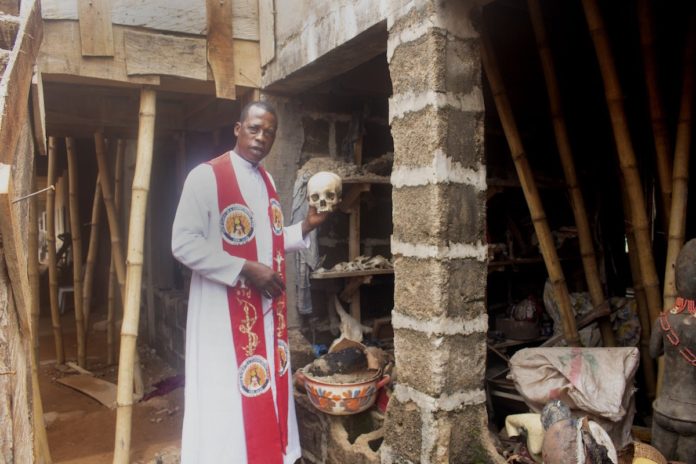
— (CNS photo/Valentine Iwenwanne)
Father Obayi’s mission challenges this fear. To him, these objects do not compete with Christianity; they testify to the spiritual depth of the Igbo. He believes a people cannot truly serve God if they despise the symbols of their ancestors. In this way, he walks a narrow path, criticized by some church members who see his work as compromise, yet respected by scholars and cultural custodians who see it as redemption.
The Meaning of Preservation
Every mask in the Deities Museum has a story. Some came from families who once held high priestly titles. Others were used in masquerade festivals, the bridge between the living and the ancestors. Each drum, each carving, carries the rhythm of centuries, the echoes of harvest songs and war dances.
Anthropologist Raphael Njoku (2009) once wrote that Igbo art is not just expression, it is memory carved in motion. The loss of these objects means the loss of the visual language that told who the Igbo were.Father Obayi knows this truth deeply. That’s why he dreams of one day building a modern museum in Nsukka, one where faith and heritage coexist, where students can walk among the gods of their ancestors without fear.
The Road Ahead
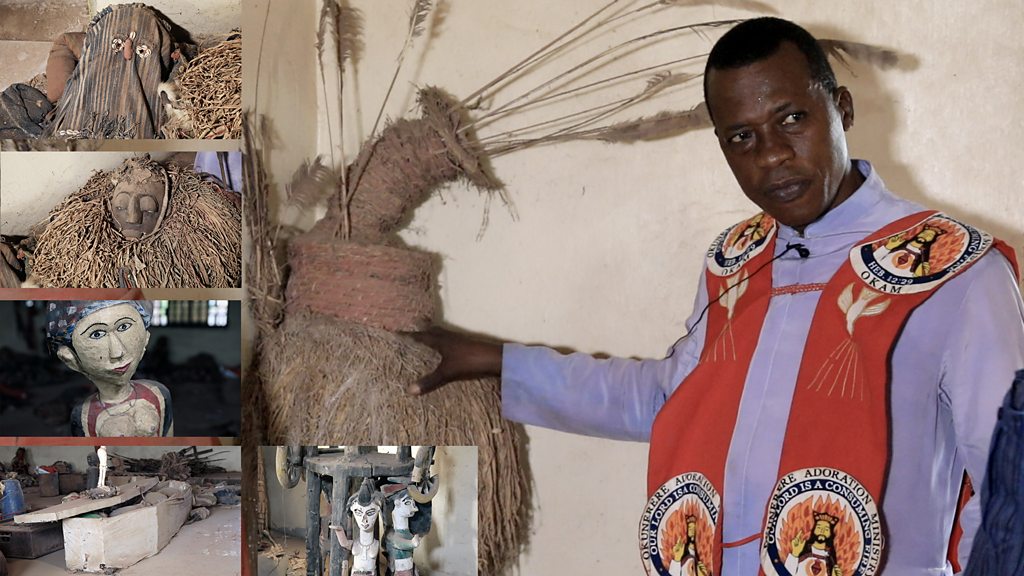
For now, the artifacts wait; dusty, scattered, fragile. Some villagers still call them evil. But others now bring their children to see them, to learn. Change begins slowly, like the soft beat of the ikoro drum calling people to gather. As Father Obayi once said, “When people see that we can preserve without worshiping, then they begin to understand that God is not afraid of culture.”
The Igbo say, “Ọnye anaghị ama ebe mmiri bidoro maba ya, agaghị ama ebe ọ ga-akwụsị” (he who does not know where the rain began to beat him will not know where it dried his body). Perhaps in Nsukka, under the quiet eyes of wooden deities, the Igbo are beginning to remember where the rain began.
Sources and references
- Catholic News Service. (2023). Catholic priest preserves traditional Igbo artifacts in Nigeria.
- Basden, G. T. (1966). Among the Ibos of Nigeria. Frank Cass & Co. Ltd.
- Njoku, R. C. (2009). Culture and customs of the Igbo of Nigeria. Greenwood Press.
- Onah, G. I. (2020). Faith and culture: Pastoral reflections from Nsukka Diocese. Nsukka: St. Theresa Publications.
Cite this article
Discussion
Sign in to join the discussion
Comments are checked by an editor before they appear. Leave a source or a correction and it is read first.
Continue reading
Related histories
 Cultural HeritageEleven Days of Nwafor Ogidi: Inside the Festival Keeping an Old Igbo Tradition AliveRead history →
 Cultural HeritageIli Ji Nkpor Obododike: The Indigenous Agricultural Ritual CycleRead history →
 Cultural HeritageMusic and Drum Traditions: Tracing the “Igbo Drum” in the AmericasRead history →
No comments yet
Nothing has been approved on this record yet. Comments are checked by an editor before they appear, so one written now shows on this page after that check.