 Ozikoro
 Biography · Published history
How Obiora Udechukwu Merged Traditional Igbo Symbolism with Post-War Nigerian Expression
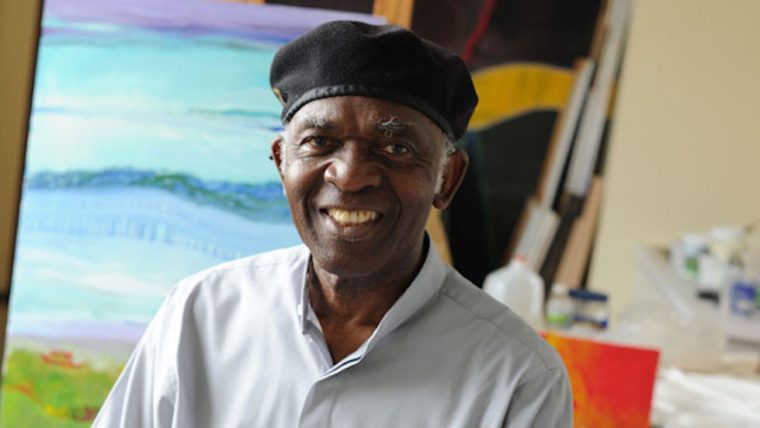
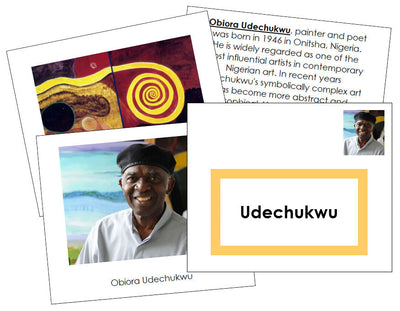
Obiora Udechukwu (born 1946 in Onitsha, Nigeria) is one of the most influential figures in contemporary African art, celebrated for his distinctive fusion of traditional Igbo visual symbolism with modern artistic expression shaped by the experience of Nigeria’s post-war realities. A central figure of the Nsukka School, Udechukwu played a crucial role in evolving Nigerian modern art by integrating indigenous uli and nsibidi motifs into postcolonial artistic practices. His work reflects not just aesthetic innovation but also deep cultural recovery and socio-political engagement. Through painting, printmaking, and poetry, Udechukwu articulated a visual language that resonates with identity, memory, resilience, and justice in post-war Nigeria.
The written record
Historical context
Early Life, Education, and War Experience
Born on June 4, 1946, in Onitsha, southeastern Nigeria, Obiora Udechukwu was exposed early in life to Igbo cultural traditions, including the uli mural painting practiced by women in his hometown of Agulu. His artistic training began at Ahmadu Bello University in Zaria, but due to rising anti-Igbo violence in northern Nigeria during the 1960s he transferred to the University of Nigeria, Nsukka. It was an environment that blended formal Western art education with a growing appreciation of indigenous aesthetics.
The Nigerian Civil War (1967–1970) also known as the Biafran War profoundly shaped Udechukwu’s early works. Serving in the Biafran Propaganda Unit during the conflict, he witnessed the human suffering of his people and documented those experiences in somber visual forms that captured flight, fear, and collective despair. His early wartime paintings, such as Silent Faces at the Crossroads (1967), depicted bent figures and pallid forms that reflected trauma as both historical testimony and artistic commentary.
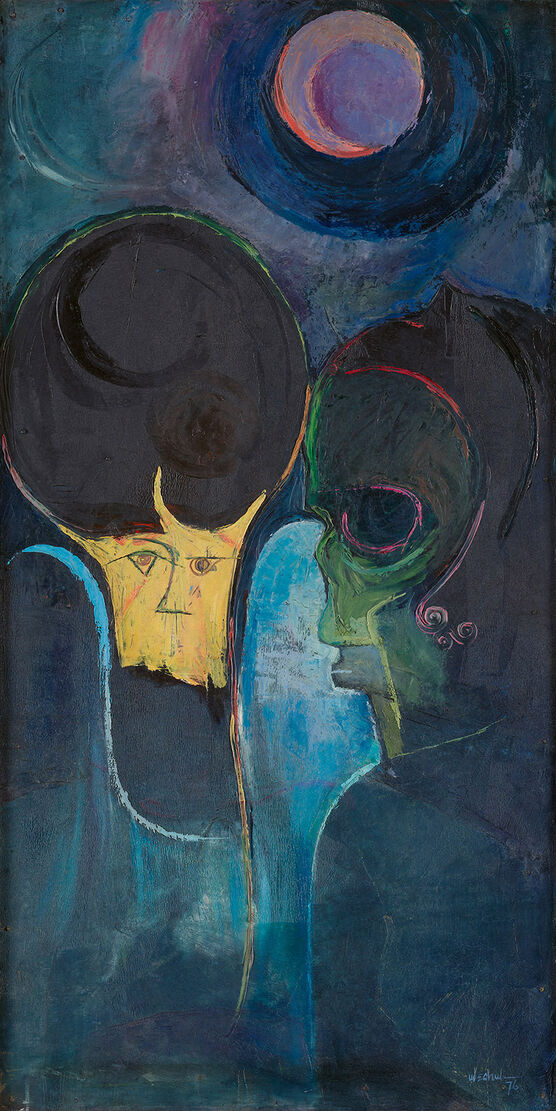
Photo credit; Tate modern in London.
The Nsukka School and Indigenous Aesthetics
After completing his Bachelor of Fine Arts in 1972 and Master of Fine Arts in 1977 at the University of Nigeria, Nsukka, Udechukwu emerged as a leader of the Nsukka School, expanding upon the work of his mentor Uche Okeke and the philosophy of Natural Synthesis. Natural Synthesis promoted the blending of indigenous artistic forms especially uli, with modern visual conventions to create uniquely Nigerian contemporary art.
This movement sought to counter the colonial legacy that treated European aesthetics as the norm for modern art. Instead, artists like Udechukwu drew upon Igbo body and wall painting traditions characterized by fluid lines, symmetry, and organic forms to generate abstract compositions that spoke to both cultural specificity and artistic universality.
Uli and Nsibidi: Symbolic Sources
Udechukwu’s artistic practice is deeply rooted in uli, an indigenous form of painting traditionally done by Igbo women on walls and bodies during rituals, festivals, and rites of passage. Uli designs emphasize linearity, rhythm, negative space, and harmony with nature. These visual principles provided a foundation for Udechukwu’s compositional language, where organic curves and fine lines became carriers of meaning.
In the late 1970s, Udechukwu also began incorporating nsibidi into his work, a system of pictographic symbols that originated with the Ejagham of southeastern Nigeria but spread through Igbo and other cultures. Nsibidi is associated with messages about social relations such as love, marriage, and kinship as well as political and moral themes. In Udechukwu’s hands, nsibidi motifs became visual metaphors that expanded the narrative capacity of his art, embedding layers of cultural meaning into modern forms.
Visual Language and Post-War Reflection
The post-war period marked Udechukwu’s most sustained efforts to integrate tradition with contemporary concerns. His works began to depict ordinary Nigerians, fishermen, dockworkers, women at water points, and others using uli-inspired linear forms to convey human dignity and socio-economic realities. Compositions from the 1970s and 1980s often addressed themes of inequality, displacement, and resilience.
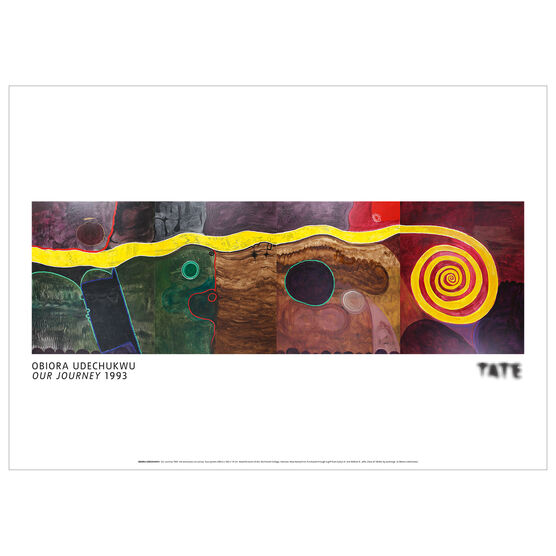
While uli provided a stylistic vocabulary, Udechukwu’s post-war works also carried deep narrative weight. They spoke not only of cultural continuity, but also of the disruptions brought by war and political upheaval. Paintings such as Refugees (1977) and No Water (1980) captured lived experiences of scarcity and displacement, while later works like Our Journey (1993) used large format panels with symbolic repetition and linear movement to reflect complex communal histories and existential quests (turn0search6).
His art thus became both representational and symbolically rooted in tradition but expressive of contemporary social consciousness.
Poetry and Artistic Synthesis
Beyond painting, Udechukwu’s role as a poet-painter further exemplified his commitment to cultural synthesis. His poetry, like his visual art, echoed themes of war, memory, identity, and moral struggle. By weaving words with images, Udechukwu created an intermedial practice in which visual and verbal expression reinforced one another; this blending opened new pathways for storytelling in African art and literature. His artworks did not simply depict forms; they communicated cultural resonance, making uli and nsibidi “alive” within modern contexts, connecting individual experience to larger communal narratives.
During his career, Udechukwu exhibited widely both in Nigeria and internationally. His works are held in collections at institutions such as the Smithsonian National Museum of African Art (Washington, DC), the National Gallery of Modern Art (Lagos), and museums in Europe and the United States. These global recognitions reflect not only aesthetic merit but also the capacity of his visual language to communicate complex cultural histories beyond national boundaries.
Art historians have noted that Udechukwu’s work offers a model for postcolonial modernism, where indigenous forms are not static or nostalgic but dynamically engaged within contemporary artistic discourse. His creativity underscores the possibility that traditional visual idioms can be fertile grounds for new forms of expression not merely preserved but regenerated.
Obiora Udechukwu’s artistic journey represents a profound integration of traditional Igbo symbolism with modern post-war expression. Through the incorporation of uli and nsibidi into painting, printmaking, and poetry, he helped shape a visual language that speaks to the complexities of identity, memory, suffering, and resilience in Nigeria’s postcolonial era. His work stands as a testament to how indigenous traditions can both inform and transcend local boundaries, contributing meaningfully to global contemporary art.
By merging deeply rooted cultural forms with modern artistic practice, Udechukwu forged a creative legacy that continues to inspire artists and cultural theorists alike reminding us that tradition and modernity need not be opposites, but fertile companions in the pursuit of expressive depth.
Sources and references
- Obiora Udechukwu: Poet-Painter of the Nsukka School. (2025, September). Nigeria234.
- Obiora Udechukwu’s Art Travels All Over the World. (2025, June 14). The Archivist / Archivi NG.
Cite this article
Discussion
Sign in to join the discussion
Comments are checked by an editor before they appear. Leave a source or a correction and it is read first.
Continue reading
No comments yet
Nothing has been approved on this record yet. Comments are checked by an editor before they appear, so one written now shows on this page after that check.