 Ozikoro
 Cultural Heritage · Published history
Idu Cultural Dance of Akpo: Tradition, Identity, and Community through Movement and Music
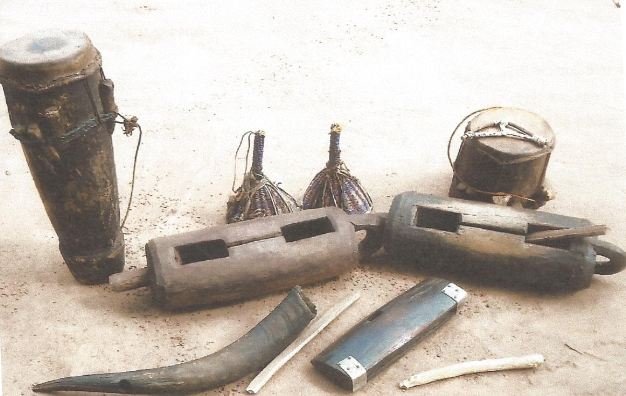
Idu cultural dance is a dance that the Akpo people borrowed from Umuomaku town more than 50 years ago. They discussed the dance with the people who owned it and did everything they asked, and then the training started. The training lasted for two years. This brought friendship between Akpo and the Umuomaku people. The music group is now called Idu Akpo. In traditional society, any music is the community’s own.
The written record
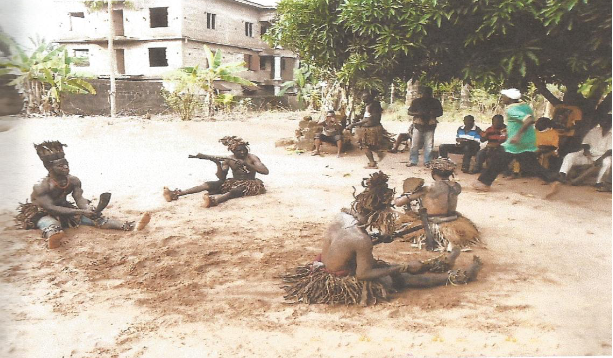
Knowing the history of any music group is important so that people can understand how the group works and what it stands for. In Igbo land, long ago, people borrowed music and instruments from neighbours. But nowadays, people don’t do it again.
Another account of the Akpo people says, “Idu dance started with a strong man in Akpo. The man is strong in wrestling, farming, and even fighting with spirits. That is why they call him the strongest.”
Historical context
To join the Idu group, you must: Be at least 30 years old, come from Ogbo village, must have joined the masquerade cult, bring four kola nuts, four alligator peppers, one gallon of palm wine and ₦200
If you do not have this requirement, you can’t be a member. The masquerade cult aspect is important because two masquerades are involved in their dance.
However, they mainly formed the Idu group to create a good entertainment group that would make the village special, raise money for development, and bring everybody together. The first show that they did had 20 members. Today, the group is well-grown. Members have talent in different things. Fighting is not allowed. If you fight, you would bring one cock and one hen, you would pay a fine if you miss a meeting without a good reason. Nobody can teach music to another group.
Rehearsal time is at night. They do not have fixed days but always rehearse two or three days before any event. The Nne ekwe drum beats inform members about the meeting.
The costumes are part of what makes them different.
Women watch the Idu dance, both in town and outside town. Only when a masquerade is present can women come near the dance floor. All costumes are locally made, and instrument players do not wear costumes.
Instruments are a very important part of dance. Groups do not buy instruments anyhow. They select well, based on the music style.
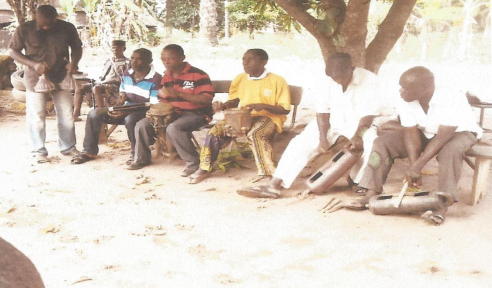
Training happens during rehearsal. New people would learn how to dance or play instruments. Instrument players are trained by old members who know it well. The group never lacked drummers or instrumental players.
Idu dancers wear only shorts and sliced dry goat skin that they sew together and tie around the waist. They also use goat skin for a cap. They wear neck beads and leg rattles. Every dancer has a knife at their waist. They rub charcoal paste on their face and body. It made them look scary and strong. Because of how they dress, people get scared when they see them.
Idu dance groups do not move much but walk slowly to reach the dance ground. So they pick light instruments, mostly for rhythm. Most of the instruments are idiophones.
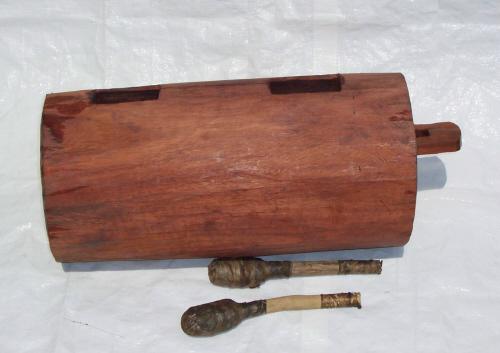
They use eight local instruments: the Nne igba (small drum), the Oke Igbo (big drum), the Nne ekwe (wooden slit drum), the Oyo (rattle), the Opu (horn), the Okpokolo (woodblock), and the Oja (flute).
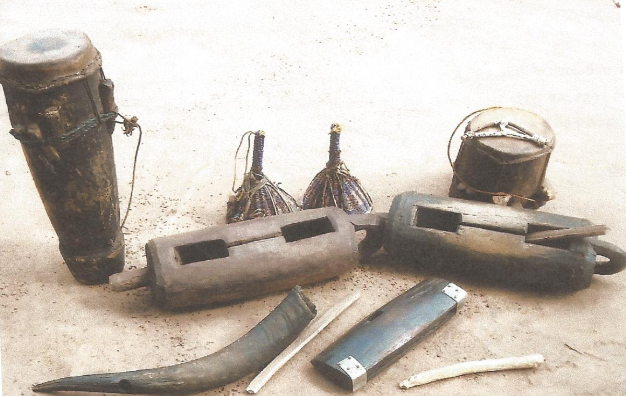
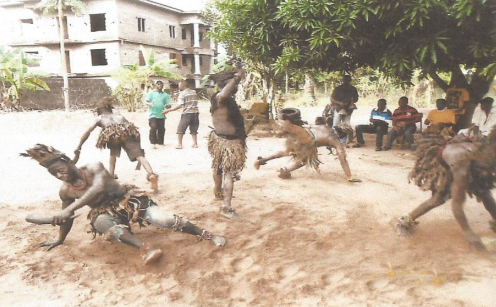
Dancers use all parts of their bodies: their heads, chests, legs, and arms. The dance movements are not small; they are complex and energetic. Even old men dance strongly.
Idu dance has four movement steps (obala egwu). Each one depends on the event.
They do not always perform all four dance steps for burial because many groups are waiting to perform. Idu dancers do not perform inside the hall; they only perform in an open space.
First Movement: Nne ekwe starts with a fast tempo; Okpokolo keeps the beat. The dancers form a circle and do zigzag moves.
Second Movement: The tempo is slightly calmer. The dancers face the centre, stamp their legs, move left and right, then sit down and move their buttocks.
Third Movement (Climax): Fast tempo, dancers swing left and right, stamp their legs, jump a little, bring out machetes, climb trees, and do a warrior display. Then the flute players call them back to order. Then ‘ida iya’ happens, this na when strong men show strength and get praise or money if people like them.
Fourth Movement: Final step with lively tempo. The Group leave the dance floor in reverse.
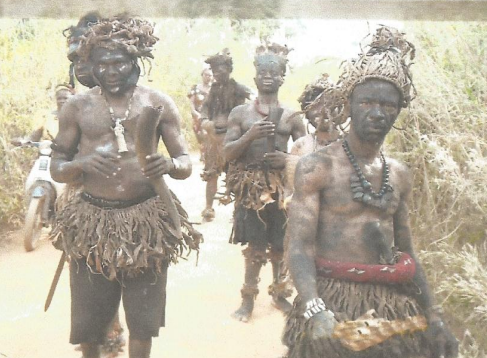
The audience enjoys the dance. Both men and women spray money at dancers or drummers. If there is a masquerade, women throw money from a distance. Idu cultural dance is one strong traditional dance that shows the power, unity and culture of the Akpo people. Everything about the dance, from how it is organised, how members are chosen, and what costume they wear, to the powerful instruments and dance steps, shows that Idu has a deep cultural meaning. Even though some people fear the costume or believe some wrong stories, the dance is peaceful and well-organised.
Idu only perform when people invite them. They can perform with or without a masquerade. If it is a condolence visit, they lead the host in with music, perform a little, and then leave. The dance is not just for entertainment; it brings people together, helps people remember their roots, and even helps raise money for community development.
Sources and references
- Akas, N. C. (2014). Indigenous dance beyond movement: A semiotic metaphor of Idu Akpo dance performance . Awka Journals of Research in Music and Arts (AJRMA), 10, 192–205.
- Chuma-Udeh, N. (2014). Music in oral literature by Sephardic Jews and Igbos of western Nigeria: A comparative analysis . Awka Journals of Research in Music and Arts, 10, 15–31.
- Ekwueme, L. U. (2008). A basic guide to music appreciation . Lagos: Apex Books.
- Ezenwata, S. M. (2012). Who is who in Akpo? A reminiscent survey of Akpo, origin and growth in synopsis . Port Harcourt: PGI Printing Concepts.
- Okpala, Nkechi H. (2016). Traditional Music in Igbo Culture: A Case Study of Idu Cultural Dance of Akpo in Aguata Local Government Area of Anambra State . Anambra State.
Cite this article
Discussion
Sign in to join the discussion
Comments are checked by an editor before they appear. Leave a source or a correction and it is read first.
Continue reading
Related histories
 Cultural HeritageEleven Days of Nwafor Ogidi: Inside the Festival Keeping an Old Igbo Tradition AliveRead history →
 Cultural HeritageIli Ji Nkpor Obododike: The Indigenous Agricultural Ritual CycleRead history →
 Cultural HeritageMusic and Drum Traditions: Tracing the “Igbo Drum” in the AmericasRead history →
No comments yet
Nothing has been approved on this record yet. Comments are checked by an editor before they appear, so one written now shows on this page after that check.