 Ozikoro
 Biography · Published history
K. O. Mbadiwe: Nationalism, Radical Rhetoric, and the Politics of Nigeria’s First Republic
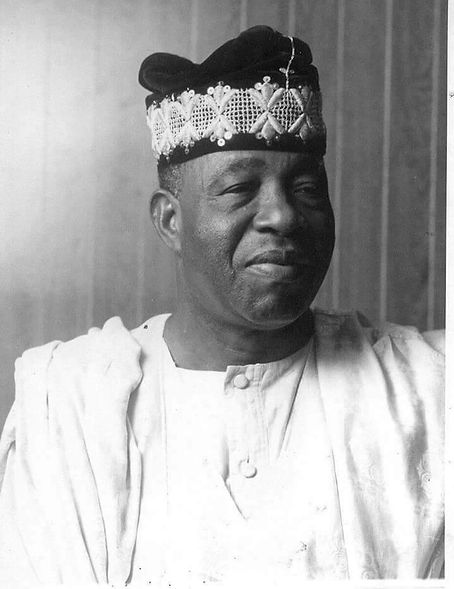
K. O. Mbadiwe (K. O. Mbadiwe, often called Kola Mbadiwe) was one of the most charismatic, controversial, and rhetorically gifted politicians of Nigeria’s nationalist era and First Republic. Remembered as much for his flamboyant oratory as for his political activism, Mbadiwe played a significant role in anti-colonial mobilization, party politics, and ministerial governance in post-independence Nigeria. His famous declaration that he was “the greatest orator of the English-speaking world” captures both the confidence and theatricality that defined his public life. Yet beyond the rhetoric lay a committed nationalist whose career reveals the tensions, ambitions, and contradictions of early Nigerian politics.
The written record
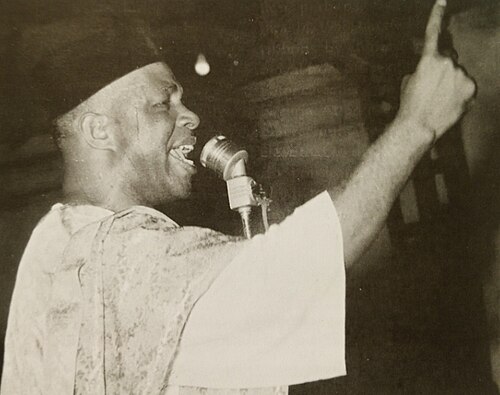
In office. Photo credit; Wikipedia.
Historical context
Early Life and Education
K. O. Mbadiwe was born in 1915 in Arondizuogu, in present-day Imo State, southeastern Nigeria. Like many nationalist leaders of his generation, he benefited from mission education before pursuing higher studies abroad. Mbadiwe studied in the United States, where he attended institutions including Lincoln University and New York University.
His education in the United States exposed him to Pan-Africanist thought, Black intellectual movements, and anti-colonial activism. This period shaped his political consciousness and sharpened his rhetorical style. Scholars note that overseas education provided nationalist leaders like Mbadiwe with both ideological tools and international networks that strengthened the Nigerian independence movement.
Entry into Nationalist Politics
Mbadiwe became politically active during the late colonial period, aligning himself with Nigeria’s growing nationalist movement. He was an early member of the National Council of Nigeria and the Cameroons (NCNC), led by Dr. Nnamdi Azikiwe. The NCNC advocated self-government, African political leadership, and constitutional reforms.
Within the NCNC, Mbadiwe quickly gained attention as a powerful speaker and mobilizer. His speeches blended nationalist fervor, dramatic delivery, and populist appeal. He saw political rhetoric as a weapon of liberation, once asserting that “words, properly spoken, can move a nation toward freedom.”
Ministerial Career and Public Service
After Nigeria’s independence in 1960, Mbadiwe held several ministerial positions at the federal level. He served at different times as Minister of Lands and Survey, Minister of Trade, and Minister of Aviation. These roles placed him at the heart of Nigeria’s early development planning.
As Minister of Aviation, Mbadiwe oversaw aspects of Nigeria’s emerging air transport infrastructure during a period when the country sought to assert sovereignty and modernity. While his tenure was marked by ambition and visibility, it also attracted criticism for extravagance and political showmanship. Nevertheless, historians argue that his ministerial career reflected the broader challenges of institution-building in a newly independent state.
Political Style and Rhetoric
Mbadiwe’s political persona was inseparable from his oratory. His speeches were dramatic, theatrical, and unapologetically self-assertive. His most famous statement, “I am the greatest orator since Cicero, and the greatest since Demosthenes” has often been quoted to illustrate his flamboyance.
However, scholars caution against dismissing Mbadiwe as merely eccentric. His rhetorical excess must be understood within the political culture of the time, when mass mobilization, personality politics, and symbolic leadership were central to nationalist movements. His speeches energized supporters and amplified nationalist sentiment, particularly among urban and youth audiences.
Controversies and Political Decline
Like many First Republic politicians, Mbadiwe’s career was not without controversy. Allegations of corruption, political rivalry, and factionalism followed him, reflecting the intense competition within Nigeria’s post-independence political elite. The crisis within the NCNC and broader regional tensions also affected his influence.
The military coup of January 1966 abruptly ended the First Republic and brought Mbadiwe’s federal political career to a close. Unlike some of his contemporaries, he did not play a prominent role in subsequent military or post-war governments, marking a sharp decline from his earlier prominence.
After his withdrawal from frontline politics, Mbadiwe lived a more private life, though his name continued to appear in discussions of Nigeria’s early political history. He died in 1990, leaving behind a complex legacy shaped by brilliance, controversy, and theatrical nationalism.
His later years were marked by relative political quiet, reflecting the broader eclipse of First Republic politicians under prolonged military rule.
Legacy and Historical Significance
K. O. Mbadiwe occupies a unique place in Nigerian history as a symbol of nationalist exuberance and the performative dimensions of politics. While he may not be remembered as a major institution-builder, his contributions to political mobilization and nationalist discourse remain significant.
His life illustrates the strengths and weaknesses of Nigeria’s early political elite: intellectual confidence, international exposure, rhetorical power, but also personal ambition and structural instability. Mbadiwe’s career reminds historians that politics is not only about policy and institutions but also about symbolism, persuasion, and public imagination.
K. O. Mbadiwe was more than a flamboyant politician; he was a product and participant of Nigeria’s nationalist struggle and early independence experiment. His rise and fall reflect the promise and fragility of the First Republic. Through his oratory, activism, and ministerial service, Mbadiwe helped shape Nigeria’s political culture during a formative era. Though often remembered for his dramatic self-assertions, his historical significance lies in his role as a voice of nationalist confidence and political expression in a nation finding its identity.
Sources and references
- Diamond, L. (1988). Class, ethnicity, and democracy in Nigeria: The failure of the First Republic. Syracuse University Press.
- Falola, T., & Heaton, M. M. (2008). A history of Nigeria. Cambridge University Press.
- Sklar, R. L. (2004). Nigerian political parties: Power in an emergent African nation. Africa World Press.
- Dudley, B. J. (1973). Instability and political order: Politics and crisis in Nigeria. University of Ibadan Press.
Cite this article
Discussion
Sign in to join the discussion
Comments are checked by an editor before they appear. Leave a source or a correction and it is read first.
Continue reading
No comments yet
Nothing has been approved on this record yet. Comments are checked by an editor before they appear, so one written now shows on this page after that check.