 Ozikoro
Biography · Published history
Madam Rosa C. Asuquo-Brown and the Fight for Women’s Right to Government Contracts in Post-War Enugu and Nigeria as a Whole
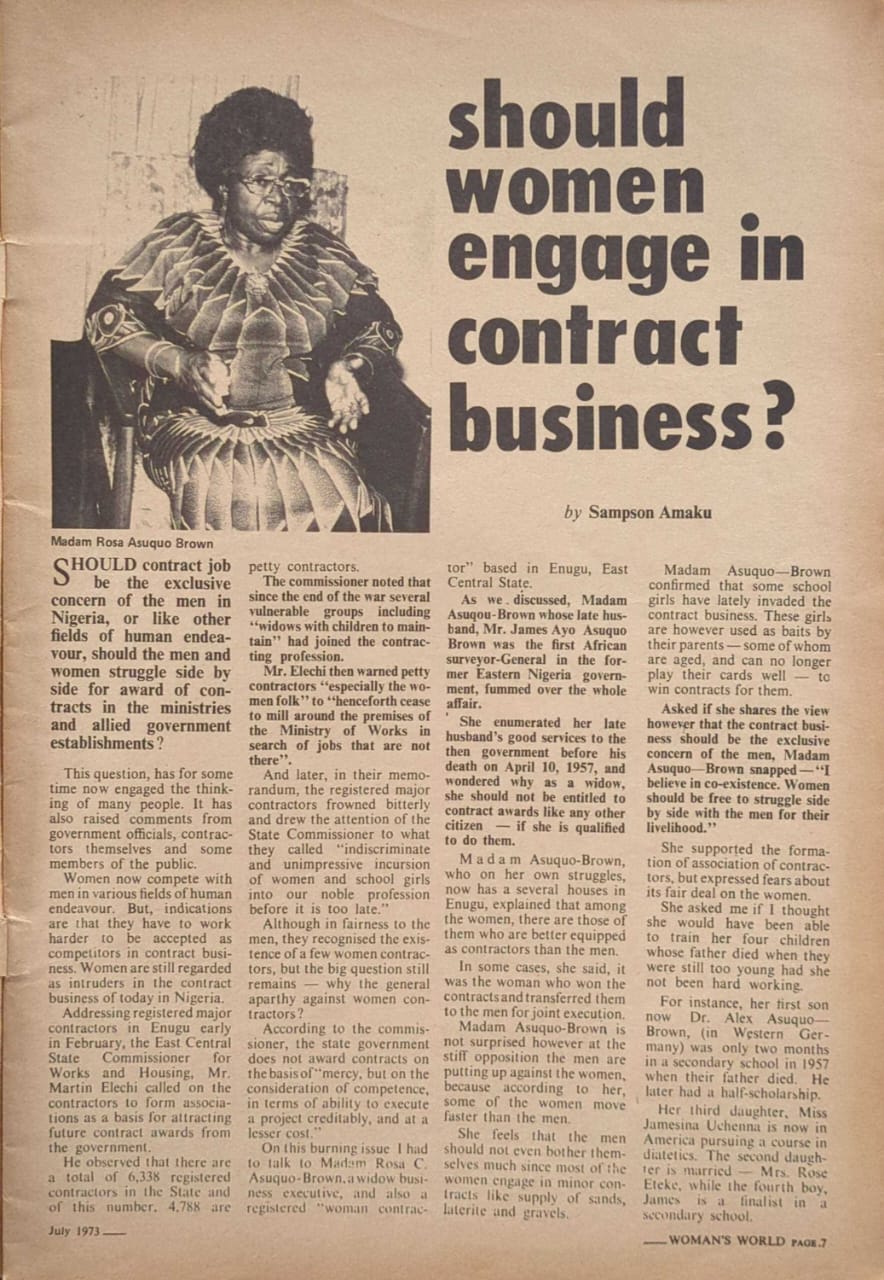
In post-civil war Nigeria, public contracting became one of the most competitive spaces in the rebuilding of infrastructure and public services. Yet, despite women’s long-standing contributions to trade, local commerce, and community development, they faced structural exclusion from this male-dominated sector. Among the pioneers who challenged this inequality was Madam Rosa C. Asuquo-Brown, a widow, businesswoman, and registered government contractor whose advocacy in the early 1970s boldly questioned the deeply rooted gender bias in contract allocation. Her struggle, publicly documented in a 1973 Woman’s World magazine feature, offers an important lens through which to understand women’s resistance, agency, and transformative roles in Nigeria’s post-war economic landscape.
The written record
Historical context
Women, Work, and Patriarchy in Post-War Nigeria
The aftermath of the Nigerian Civil War (1967–1970) left southeastern Nigeria, including Enugu, in significant need of reconstruction. Roads, schools, drainage systems, and markets needed rebuilding, and the government increasingly relied on registered contractors to execute these projects. However, as historians note, Nigerian public contracting remained heavily gendered, shaped by Victorian-era colonial norms that positioned public financial roles as male domains (Mba, 1982). This was in contrast to precolonial Igbo and Ibibio societies where women actively participated and were in trade and production.
Thus, the exclusion that women like Asuquo-Brown faced was not indigenous but a colonial legacy reinforced by post-independence bureaucratic structures.
The 1973 Debate: Should Women Engage in Contract Business?
The 1973 debate captured in Woman’s World magazine reveals the intensity of public opinion regarding women contractors. Many male contractors and some government officials believed that women were “intruders” in the contracting industry. Mr. Martin Etiong, then East Central State Commissioner for Works and Housing, expressed concern about what he described as “indiscriminate admission” of women including widows and mothers into contracting. This reflected a broader anxiety: that the male monopoly over state resources was being disrupted.
A memo from the Registered Major Contractors Association also criticized female entrants, particularly “school girls” whose involvement they viewed as morally questionable. The hostility towards women in contracting highlighted a patriarchal fear of losing control over lucrative state opportunities.
Against this backdrop, Madam Rosa C. Asuquo-Brown emerged as a courageous and articulate defender of women’s right to economic participation.
Madam Asuquo-Brown: A Pioneer Contractor and Public Advocate
According to the 1973 article, Madam Asuquo-Brown became a widow on April 10, 1957, after the death of her husband, Mr. James Ayo Asuquo Brown, the first African Surveyor-General in the former Eastern Nigeria Government. Following his death, she transitioned into contract work, ensuring the continuity of her family’s livelihood.
Operating in Enugu, she became one of the few registered women petty contractors in the region. Her involvement, spanning school repairs, small road maintenance, and minor construction, challenged societal expectations that women should remain confined to domestic roles.
When asked whether women should be excluded from government contracting, she responded sharply: “I believe in co-existence. Women should be free to struggle side by side with men for their livelihood.” Her stance emphasized equality, competence, and fairness, values at the core of Nigeria’s democratic aspirations.
Gender, Widowhood, and Economic Survival
Widowhood played a significant role in Asuquo-Brown’s activism. By the early 1970s, Nigerian widows often faced cultural and economic marginalization, including loss of property and diminished access to family support. Asuquo-Brown’s critique of gender exclusion was thus shaped by her lived experience of providing for several children as a single parent.
Her insistence that widows not be barred from contract opportunities “if she is qualified to do them”, was both a feminist and economic argument. She stressed that widows not only deserved space in public contracting but often worked harder and performed better than men because their survival depended on it.
Women Contractors as Symbols of Modern Nigerian Womanhood
While some critics argued that contracting was too “rugged” for women, Asuquo-Brown highlighted that women had historically excelled in trade, craft, and production. Her argument aligns with scholarship noting that Igbo, Ibibio women played central roles in market organization, palm oil trade, pottery, and local governance prior to colonialism.
Thus, women’s exclusion from modern contracting was an artificial barrier not a natural or cultural one. Her personal story also demonstrated the modern Nigerian woman as economically active, politically aware, family-centered, and unafraid to challenge injustice.
Public Backlash and Structural Resistance
Despite her competence, Asuquo-Brown acknowledged that some men felt threatened by women’s participation. She noted that female contractors were sometimes assigned only minor jobs such as gravel supply or school repairs, while more lucrative contracts were redirected back to male colleagues.
This reflects wider structural discrimination documented in Nigerian public finance, where women contractors often struggle to access capital, approvals, and political connections. Her advocacy helped expose these barriers and contributed to the conversation on gender equality in Nigeria’s emerging bureaucracy.
The Legacy of Rosa C. Asuquo-Brown
Madam Asuquo-Brown’s life underscores the resilience of women who navigated post-war economic hardship while refusing to accept patriarchal exclusion. She also invested heavily in her children’s education, one daughter studied in the United States as a dietician, and others excelled in schools. Her emphasis on education and economic independence reflects the broader goals of the women’s movement in Nigeria during the 1970s.
Her story stands as an important chapter in the history of Nigerian women in business, bridging precolonial traditions, colonial challenges, and post-war reconstruction. Madam Rosa C. Asuquo-Brown’s fight for women’s rights to government contracts in post-war Enugu represents a defining moment in Nigeria’s gender and economic history. Her bold public advocacy, resilience as a widow, and insistence on fairness challenged the structural barriers that sought to confine women to the margins of public economic life. Through her voice and actions, she expanded the boundaries of what Nigerian women could aspire to and achieve. Her story remains both a historical lesson and a contemporary inspiration.
Sources and references
- Woman’s World Magazine. (1973, July). Should women engage in contract business? Lagos: Woman’s World Publications. (Original source of interview with Madam Rosa C. Asuquo-Brown).
Cite this article
Discussion
Sign in to join the discussion
Comments are checked by an editor before they appear. Leave a source or a correction and it is read first.
Continue reading
No comments yet
Nothing has been approved on this record yet. Comments are checked by an editor before they appear, so one written now shows on this page after that check.