 Ozikoro
 Biography · Published history
Paul Robeson: Voice, Resistance, and Global Legacy
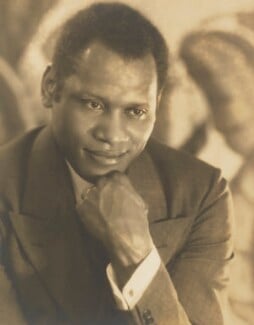
Paul Robeson remains one of the most influential African American cultural figures of the twentieth century. His legacy spans music, theatre, film, athletics, and human-rights activism. More than an entertainer, Robeson used his artistic gifts and global visibility to challenge racial injustice, colonial oppression, and economic inequality. His life reflects the power of art as a tool for political resistance and the burden carried by Black public figures in the era of segregation and global imperialism.
The written record
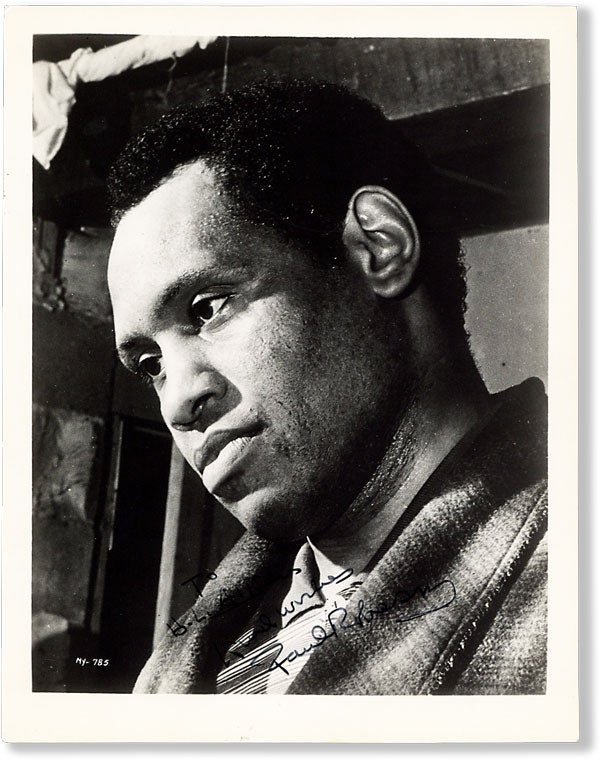
Inscribed Photographic Portrait of Paul Robeson, ca 1940s.
Photo credit: Lorne bair.com
Historical context
Early Life and Academic Excellence
Paul Leroy Robeson was born in Princeton, New Jersey, to Rev. William Drew Robeson, a formerly enslaved man who became a respected pastor, and Maria Louisa Bustill, a teacher from a prominent African American Quaker family. Robeson’s upbringing emphasized discipline, education, and racial pride, shaping his later commitment to justice.
As a brilliant student, he earned a scholarship to Rutgers University, where he became one of the most decorated African American athletes of his time. He excelled in football, basketball, baseball, and track, earning “All-American” honors twice. Robeson later studied law at Columbia University, balancing his legal education with a growing passion for music and performance.
Rise to International Artistic Fame
The Actor and Singer.
Robeson’s artistic talent propelled him onto global stages. His deep, resonant baritone voice made him famous for spirituals such as “Ol’ Man River,” a song he later reinterpreted to reflect resistance rather than resignation. As an actor, his performances in “Othello,” “The Emperor Jones,” and “Show Boat” earned international acclaim.
Cultural Preservation and Interpretation.
Robeson treated African American spirituals not merely as songs but as historical testimonies of survival and resistance. He believed that “folk music is the chronicle of a people’s struggles”, advocating for the preservation of marginalized cultures worldwide.
Political Awakening and Global Activism
Resistance to Racism in America
Robeson became an outspoken critic of segregation and racial violence in the United States. He openly condemned lynching, employment discrimination, and the exclusion of Black Americans from political institutions.
His activism was rooted in the belief that all people, regardless of race or nationality, deserved dignity and self-determination.
His political interests extended beyond the U.S. He supported African independence movements and spoke against European colonialism. He built alliances with African, Caribbean, and Asian activists, emphasizing that racism and colonialism were interconnected global injustices.
Robeson also supported workers’ rights, believing that economic oppression was as destructive as racial oppression. His ties with labor organizations, both in the U.S. and abroad, reinforced his internationalist worldview.
Cold War Politics and Suppression
Accusations and Persecution
Robeson’s refusal to conform to Cold War anti-communist sentiment led to severe government backlash. After publicly criticizing U.S. policies and advocating peaceful relations with the Soviet Union, he was blacklisted, his concerts were canceled, and his passport was revoked between 1950 and 1958.
During a 1956 hearing before the House Un-American Activities Committee (HUAC), Robeson famously refused to denounce his political beliefs, stating, “My father was a slave, and my people died to build this country, and I am going to stay here and be a part of it”.
The political assault damaged Robeson’s mental and physical health and limited his artistic opportunities. Despite this, he remained a symbol of resistance for civil rights activists and anti-colonial movements.
After his passport was restored in 1958, Robeson resumed international performances in Europe and Africa. Though his health declined in the 1960s, his influence remained profound.
Robeson’s legacy extends beyond entertainment, he inspired African American civil rights leaders such as Martin Luther King Jr. His advocacy influenced Pan-African movements, his reinterpretation of Black music shaped ethnomusicology and African diaspora studies. Also, his resistance to political persecution has become a major case study in free speech debates.
Today, Robeson is remembered as a global humanist whose life embodied courage, integrity, and the pursuit of equality.
Paul Robeson’s life demonstrates the power of art combined with political conviction. As a singer, actor, scholar, and activist, he challenged racism, colonialism, and economic injustice across continents. His courage in the face of state repression reveals the sacrifices required in the struggle for human rights. In the twenty-first century, Robeson remains a towering figure whose voice both literal and symbolic, continues to inspire movements for justice, liberation, and cultural pride.
Sources and references
- Haywood, H. (1998). Paul Robeson: The Great Forerunner. International Publishers.
- Robeson, P. (1958). Here I Stand. Beacon Press.
- Robeson, P. (1976). The Undiscovered Paul Robeson: An Artist’s Journey. Oxford University Press.
- The Schomburg Center for Research in Black Culture. (2020). Paul Robeson archival collections.
Cite this article
Discussion
Sign in to join the discussion
Comments are checked by an editor before they appear. Leave a source or a correction and it is read first.
Continue reading
No comments yet
Nothing has been approved on this record yet. Comments are checked by an editor before they appear, so one written now shows on this page after that check.