 Ozikoro
 Biography · Published history
The Merchant Prince of the Niger Delta: Chief Nana Olomu and the Commercial Empire of the Benin River
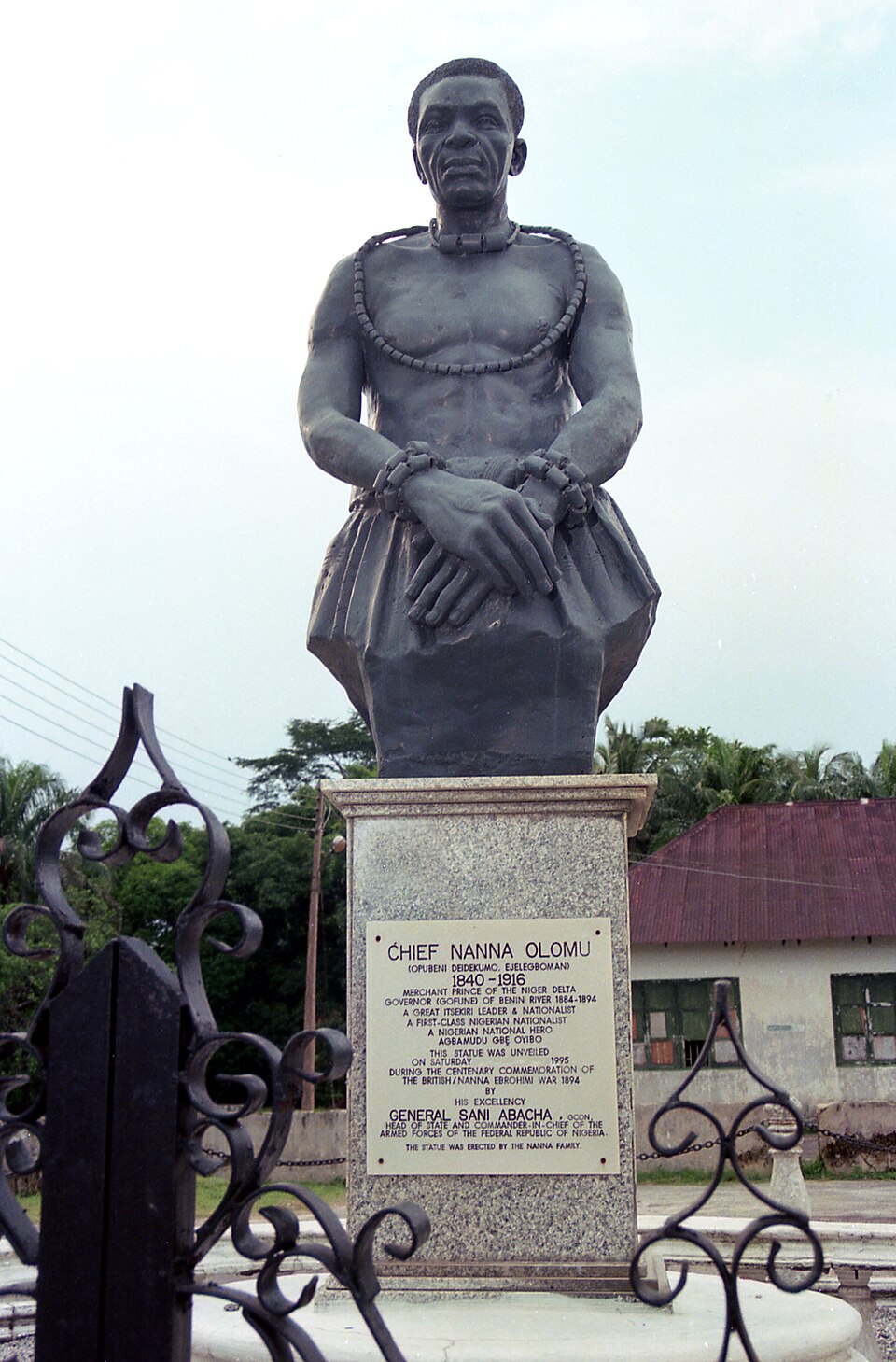
The history of the 19th-century Niger Delta is often defined by the collision between indigenous African commercial structures and the encroaching tide of British imperialism. At the heart of this narrative stands Chief Nana Olomu (1852–1916), an Itsekiri merchant-prince whose wealth, administrative acumen, and military might earned him the title of “Governor of the Benin River.” His rise and eventual fall symbolize the transition from the era of “legitimate commerce” in palm oil to the formal colonial subjugation of the Nigerian coastline. Nana was not merely a trader; he was a statesman who built a commercial empire that rivaled British interests, ultimately leading to one of the most significant military confrontations in West African colonial history.
The written record
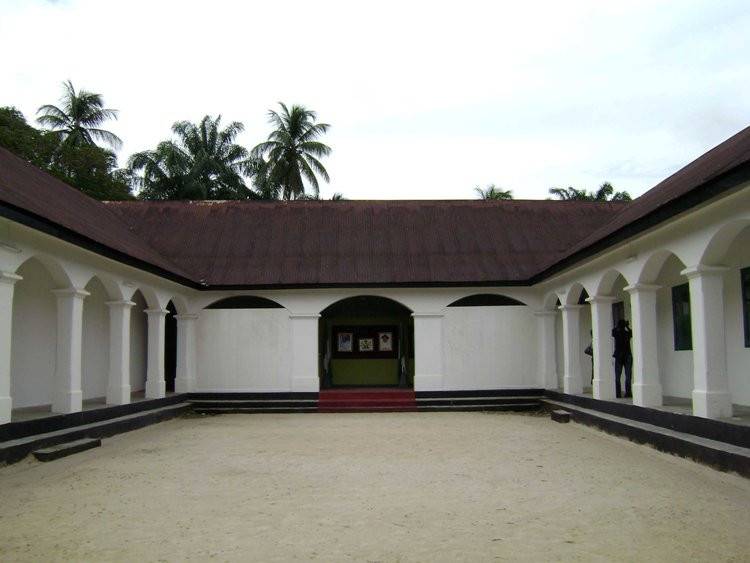
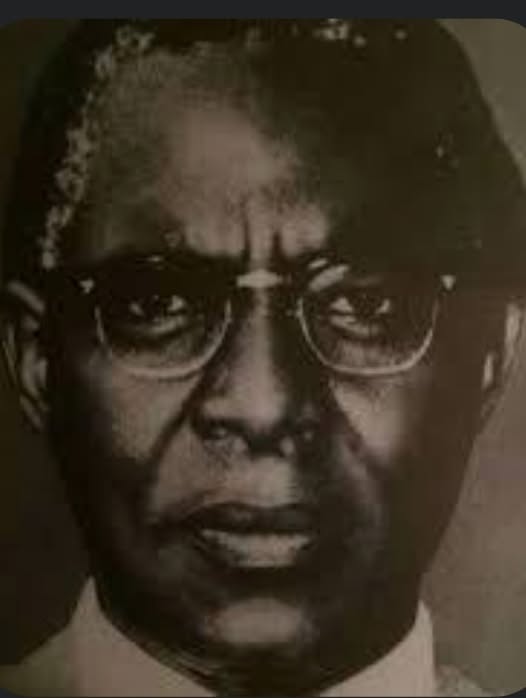
Photo Credit: National Commission for Museums and Monuments, Nigeria.
Historical context
The Foundation of an Empire: Heritage and Early Life
Nana Olomu was born into the Ologbotsere family, a lineage deeply embedded in the political and economic fabric of the Itsekiri people. His father, Olomu, was a formidable merchant who had already established a dominant position in the palm oil trade.
- The Succession of Wealth: Upon his father’s death in 1883, Nana inherited a vast commercial infrastructure, including a fleet of war canoes, thousands of enslaved laborers, and established trade routes into the Urhobo hinterland.
- Strategic Literacy: Unlike many of his contemporaries, Nana understood the value of Western administrative tools. He employed clerks to keep meticulous records of his trade, ensuring his “commercial empire” was managed with bureaucratic precision.
The Title of “Governor of the Benin River”
In 1884, the British authorities, recognizing Nana’s undisputed influence, formally appointed him as the “Governor of the Benin River.” This was not just an honorary title; it was a recognition of his role as the primary intermediary between the interior producers and the European firms at the coast.
- Maintaining Order: As Governor, Nana was responsible for settling disputes between different ethnic groups and ensuring the “flow of trade” remained uninterrupted.
- The Protectorate Treaty: In July 1884, Nana signed a treaty with the British placing Itsekiri land under British protection. However, he famously refused to sign Article VI, which advocated for “free trade.” Nana understood that “free trade” was a British euphemism for breaking his monopoly.
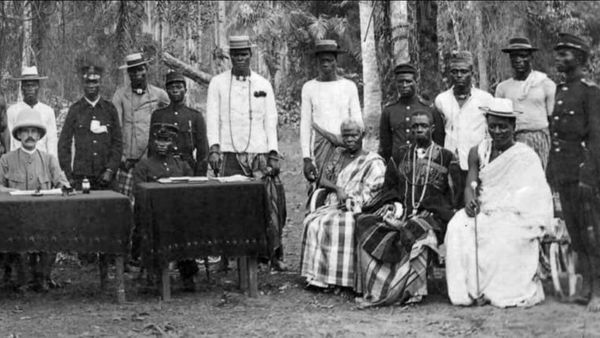
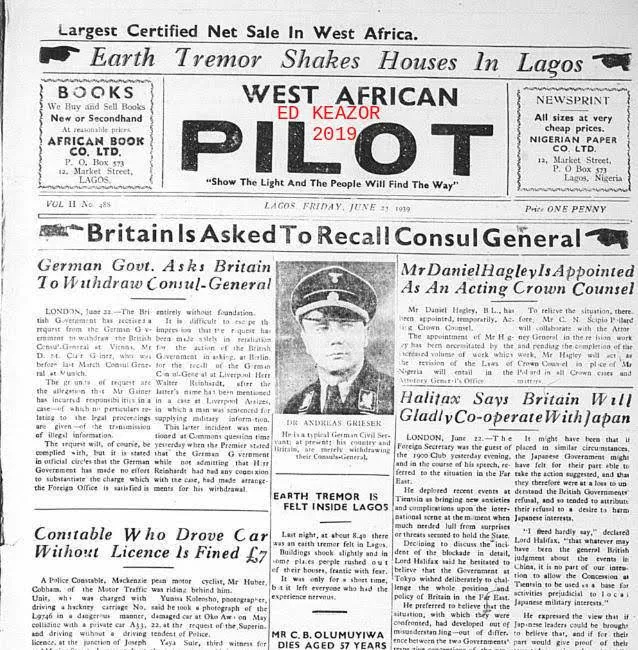
Photo Credit: The National Archives (UK) / Foreign and Commonwealth Office Collection.
The Architecture of the Commercial Empire
Nana’s empire was built on the “Palm Oil” trade, which had replaced the Atlantic slave trade as the primary export of the region. His operations were characterized by a sophisticated integration of logistics and force.
- Monopoly in the Hinterland: Nana controlled the markets of the Urhobo and Isoko people. He provided these interior producers with European goods (cloth, gin, gunpowder) in exchange for palm oil.
- Logistics and Transport: His capital, Ebrohimi, was a fortified town strategically located in the mangrove swamps. From here, he could deploy over 100 war canoes, some mounted with brass cannons, to protect his trade fleets and enforce his prices.
- Labor and Social Structure: Like many coastal potentates, Nana’s “empire” relied on the House System. He commanded thousands of dependents who functioned as both his commercial agents and his standing army.
Conflict with the British: The Road to Ebrohimi
The relationship between Nana and the British began to sour in the late 1880s. As the British “Oil Rivers Protectorate” transitioned into the “Niger Coast Protectorate,” the colonial administration sought direct access to the hinterland markets.
The Charge of “Terrorism”: British officials, particularly Acting Consul James Robert Phillips, accused Nana of “disrupting trade” and using “terror tactics” to prevent Urhobo producers from dealing directly with Europeans. In reality, Nana was simply out-competing the British firms.
Economic Sabotage: To weaken him, the British imposed “trade sanctions” and demanded he remove his war canoes from the river. Nana, sensing an impending invasion, fortified Ebrohimi with state-of-the-art fortifications and heavy artillery purchased from European rogue traders.
The Ebrohimi Expedition of 1894
The “Ebrohimi War” remains a testament to Nana’s military foresight. In August 1894, the British launched a full-scale naval assault on his capital.
The Siege: For weeks, Nana’s forces held off the British Royal Navy. The swampy terrain and Nana’s “hidden batteries” of cannons caused significant frustration for the British forces.
The Fall of the City: Eventually, the British discovered a secret path through the swamps. Ebrohimi was bombarded and burned. While Nana escaped to Lagos, his vast wealth including over 5,000 cases of gin and hundreds of cannons was seized as “spoils of war.”
Exile and Legacy
Nana eventually surrendered to the British in Lagos. He was tried and found guilty of “breaching the peace” and “opposing the Queen’s authority.”
- Life in Exile: He was exiled to the Gold Coast (modern-day Ghana). During his exile, he continued to maintain his dignity, often seen in Western suits, symbolizing his adaptation to the changing world.
- Return and Death: In 1906, the British allowed him to return to the Niger Delta. He spent his final years at Mayuku town (now Nana Town), where he died in 1916.
Chief Nana Olomu was a man caught between two worlds. He was a “traditionalist” who utilized the ancient House System of the Niger Delta, but he was also a “modernist” who understood global markets and international law. His commercial empire was a victim of its own success; it was so efficient and powerful that the British Empire could not tolerate its existence. Today, the Nana Living History Museum in Koko stands as a monument to his legacy, reminding the world of an African leader who dared to challenge the economic hegemony of the British Empire.
Sources and references
- Ayandele, E. A. (1970). The Missionary Impact on Modern Nigeria, 1842-1914: A Political and Social Analysis. Longman.
- Dike, K. O. (1956). Trade and Politics in the Niger Delta, 1830-1885: An Introduction to the Economic and Political History of Nigeria. Oxford University Press.
- Ikime, O. (1966). Nana Olomu: Merchant Prince of the Niger Delta. Heinemann Educational Books.
- Ikime, O. (1977). The Fall of Nigeria: The British Conquest. Heinemann.
- Sagay, I. (1980). The Benin Kingdom and the Edo – Speaking Peoples of South-Western Nigeria. International African Institute.
Cite this article
Discussion
Sign in to join the discussion
Comments are checked by an editor before they appear. Leave a source or a correction and it is read first.
Continue reading
No comments yet
Nothing has been approved on this record yet. Comments are checked by an editor before they appear, so one written now shows on this page after that check.