 Ozikoro
Anthropology and Ethnography · Published history
Ala, Ani, Ana, Elí, Ali Aja – The Earth Mother/Goddess in Igboland
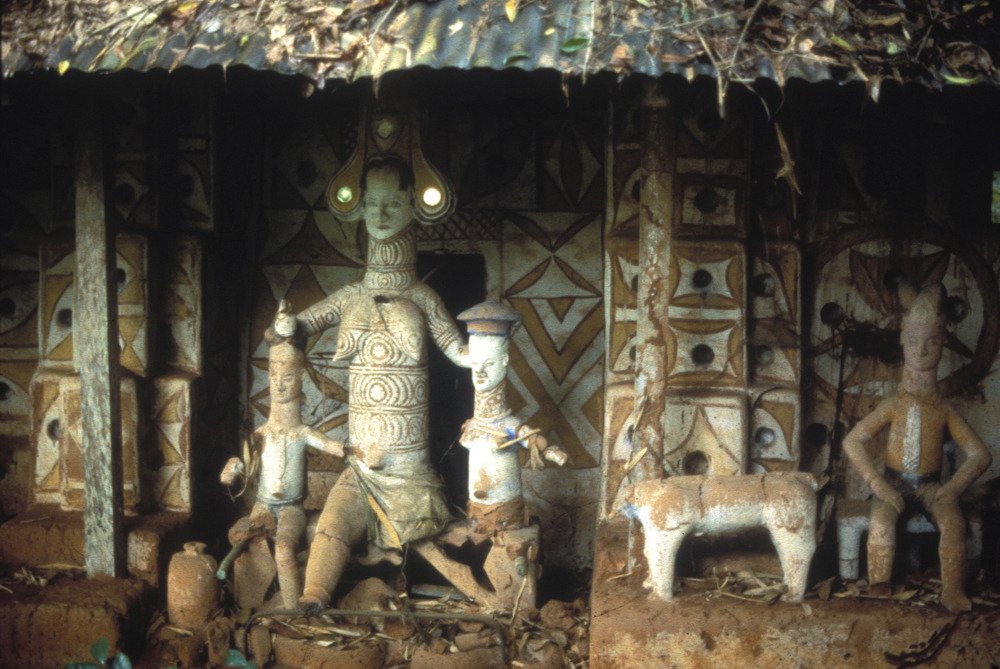
In Igbo traditional religion and cosmology, Ala, also known in different Igbo-speaking communities and dialects as Ani, Ana, Ali, Ale or Eli, is the personification of the earth and one of the most important divine powers in the traditional Igbo religious universe.
The written record
The name itself is closely connected with the Igbo word ala, meaning earth, ground or land. Ala is therefore not merely a goddess associated with the earth: in many traditional understandings, the earth itself is sacred and is understood through the personhood of Ala.
She occupies a particularly important position because the earth is simultaneously the source of human life, agricultural production, moral order and the final resting place of the dead. The Earth Mother consequently connects the living, the land, the ancestors and the moral order of society.
Historical context
The domains of Ala:
Ala’s importance can be understood through several interconnected responsibilities.
Fertility and agriculture
Ala is associated with the fertility of both the soil and human beings. Agricultural abundance, successful cultivation and the production of food are therefore connected to the wellbeing of the earth.
This relationship was particularly significant in agricultural societies where the survival of the community depended upon the fertility of the land. Yams, other crops, children and the continuation of the community could all be understood within a broader system of fertility governed by the sacred earth.
The connection between Ala, fertility and agriculture is strongly documented in ethnographic and scholarly accounts of Igbo religion.
Morality and justice
Ala is also the guardian of morality, custom and social order.
Serious violations of traditional moral law could be understood as offences against the earth itself. Such offences are commonly described through concepts such as nsọ Ala—an abomination or violation against Ala.
The significance of this idea is profound: wrongdoing was not simply a private offence between individuals. Certain actions could be understood as disturbing the relationship between the individual, the community and the sacred earth. Traditional Igbo moral systems therefore connected morality, ritual purity, communal wellbeing and the sanctity of the land.
This is why Ala is frequently described as a guardian of Igbo morality and customary order. The earth was not regarded as an inert piece of property; it was sacred and capable of being offended or polluted.
Protection and guardianship
Ala is also understood as a protective maternal power. Her relationship with the community encompasses the protection of families, children, agricultural life and the land upon which society depends.
This protective dimension follows naturally from her broader identity as Earth Mother: she is simultaneously the source that gives life and the sacred power whose laws must be respected.
Spiritual guidance
Ala’s role also extends into the spiritual and communal life of the people. Through her connection with custom, morality, fertility and the ancestors, she provides an important framework through which communities understand right conduct, prosperity, misfortune and their relationship with the sacred world.
Her importance is therefore much broader than that of a specialised agricultural deity. In the traditional Igbo worldview, land, morality, fertility, death and community are interconnected, and Ala stands at the centre of those relationships.
The Earth Mother across Igbo communities
The worship and veneration of the Earth Mother was not expressed identically throughout Igboland. Igbo traditional religion was highly decentralised, and the names, rituals, symbols and relative importance of particular deities could vary considerably between communities.
Consequently, Ala, Ani, Ana, Ali, Ale and Eli should not automatically be treated as six entirely separate goddesses. In many contexts they represent regional or dialectal forms of the Earth Mother, although local traditions could give the deity particular attributes and names.
The following communities are associated in the tradition and literature with the Earth Mother:
- Mbano (Imo) — Ala, including representation in Mbari traditions.
- Oratta/Uratta (Imo) — Ala, with a particularly significant cult and Mbari tradition.
- Mbaise (Imo) — Ala, including her representation in Mbari.
- Ikwerre (Rivers/Imo region) — Ala, associated in the tradition with Mbari.
- Etche (Rivers/Imo region) — Ala/Ale, including important Mbari traditions.
- Isu (Anambra/Imo) — Ala, associated with the Earth Mother tradition.
- Oru (Imo) — Ala.
- Ibeku (Abia) — Ala.
- Egbema (Imo/Rivers region) — Ali, another form of the Earth Mother.
The strongest historical evidence for the connection between Ala and Mbari comes from the Owerri-area traditions. Herbert M. Cole’s work on Owerri Igbo art describes Ala as the dominant all-purpose deity of the Owerri Igbo and the central figure for whom communities constructed elaborate Mbari houses.
Percy Amaury Talbot’s Some Nigerian Fertility Cults, based on early twentieth-century observations, likewise records the worship of Ala/Ale among the Owerri and Etche areas and describes Mbari structures dedicated to the Earth Goddess.
The Oratta connection is also specifically documented in historical material describing the highly institutionalised cult of Ala among the Oratta-Owerri, with Mbari functioning as one of its most important artistic expressions.
Significant regional presence
Beyond the communities in which the Ala/Ali tradition is particularly prominent, the Earth Mother is also associated with a wider range of Igbo communities.
These include:
- Ogba (Rivers) and Ohafia (Abia) — Ala
- Nri (Anambra) and Nnewi (Anambra) — Ana
- Nsukka (Enugu) and Ukwuani (Delta) — Ani
The inclusion of these communities is important because the presence of the Earth Mother should not be understood as something restricted exclusively to the Owerri or Imo region. Ala is a much wider feature of Igbo religious thought, although the form her worship takes differs considerably from one locality to another.
For example, modern ethnographic and historical work continues to document Ala as an important deity in Ukwuani religious landscapes, where shrines to the Earth Goddess exist alongside shrines associated with ancestors and other local spiritual powers.
Likewise, descriptions of Igbo religious thought generally place Ala within the wider religious vocabulary of communities extending across Igboland.
How Ala was traditionally revered
The veneration of Ala could take many forms, depending upon the community.
Offerings and sacrifices
Offerings could include yams, fruits and animals, alongside other ritual materials appropriate to the particular community and occasion.
Food was especially significant because agricultural prosperity was intimately connected with the sacred earth. Talbot’s ethnographic observations record offerings involving yams and animals in Earth Goddess traditions.
Rituals and ceremonies
Ala was honoured through ritual ceremonies connected with agriculture, fertility, morality, purification and communal wellbeing.
The New Yam Festival is particularly relevant to this relationship because the agricultural cycle and the first fruits of the yam harvest were embedded within a wider religious understanding of fertility and the land.
It would, however, be more accurate to say that New Yam celebrations involve the religious relationship between the people, the land and the divine, rather than claiming that every Igbo community historically understood the festival in the same way.
Sacred places and symbols
Ala’s presence could be represented through shrines, sacred earth spaces, stones, groves and Mbari structures, depending on the community.
Among the Owerri Igbo, the most spectacular expression was the Mbari house.
Mbari were elaborate, open-sided structures filled with painted clay sculptures representing deities, humans, animals and aspects of the social and spiritual world. Ala frequently occupied a central position within these compositions. The structures were not simply permanent temples: their eventual decay and return to the earth formed part of their ritual meaning.
Taboos and prohibitions
Respect for Ala was also expressed through taboos and prohibitions.
Acts regarded as serious violations of the moral order could be classified as offences against the earth. Such violations were not understood merely as breaking a human law; they could be regarded as polluting or desecrating Ala herself.
This is the religious foundation behind concepts such as nsọ Ala, which appear throughout discussions of traditional Igbo morality.
Ala, Chukwu, Chi and the wider Igbo cosmos
Ala should also be understood within the wider structure of Igbo cosmology.
Traditional Igbo religion recognises a supreme creative principle generally referred to as Chukwu/Chineke, alongside numerous alusi or divine powers associated with different aspects of existence.
Ala is one of the most important of these powers.
She is therefore sometimes presented as occupying a position alongside other major divine forces such as Chi and Anyanwu, although the exact theological relationship between these beings varies between Igbo communities and should not be reduced to a single uniform pantheon.
In particular, Chi is not simply interchangeable with another deity such as Ala; the concept of Chi has its own complex meaning concerning personal destiny and spiritual individuality.
Similarly, Anyanwu is associated in Igbo traditions with the sun and its life-giving qualities. Some modern summaries therefore place Ala, Chi and Anyanwu together when discussing major elements of Igbo cosmology, but traditional Igbo religious systems were not organised around one universally standardised pantheon.
A better way to understand Ala is therefore as one of the central divine powers through which the Igbo relationship with the earth, morality, fertility and ancestral existence was expressed.
Ala as the meeting point of life, morality and death
Perhaps the most profound aspect of Ala is that she connects birth, life, food, morality and death.
The same earth that receives the seed and produces the yam also receives the body of the deceased. The land therefore becomes both mother and final resting place.
This explains why the earth could not simply be treated as an economic possession. To violate the land was, in a religious sense, to violate a sacred being.
Igbo traditional thought consequently placed enormous importance on maintaining harmony between people, the community and the earth. Crimes against Ala threatened not only the individual but potentially the moral and spiritual balance of the wider community.
Ala was thus simultaneously:
- Earth Mother
- Giver of fertility
- Source of agricultural abundance
- Guardian of morality
- Custodian of custom
- Judge of certain forms of wrongdoing
- Protector of communal order
- Receiver of the dead
- A meeting point between the living and the ancestors
This extraordinary combination helps explain why Ala became one of the most widespread and enduring divine figures in Igbo religious thought.
The Earth Mother known variously as Ala, Ani, Ana, Ali, Ale and Eli represents one of the deepest ideas in traditional Igbo cosmology: the earth is alive, sacred and morally consequential.
She is not merely a fertility goddess. Her significance extends from the cultivation of food to the birth of children, from customary law to the punishment of abominations, from the protection of the community to the burial of the dead.
Her presence across communities such as Mbano, Oratta, Mbaise, Ikwerre, Etche, Isu, Orsu, Oru, Ibeku, Egbema, Ogba, Ohafia, Nri, Nnewi, Aro, Edda, Ishielu, Nsukka and Ukwuani demonstrates the breadth of the Earth Mother tradition, even though her name, rituals and local expression varied from one community to another.
The Mbari tradition of the Owerri and neighbouring Igbo peoples provides perhaps the most visually striking expression of this relationship: communities built enormous clay structures and filled them with representations of the divine and human worlds, placing Ala at the centre of a sacred artistic universe that ultimately returned to the earth from which it came.
In this sense, Ala embodies a central principle of Igbo religious thought: human beings live from the earth, live upon the earth, are morally accountable to the earth, and ultimately return to the earth.
Sources and references
- Elizabeth Isichei, A History of the Igbo People (Macmillan, 1976
- Percy Amaury Talbot, Some Nigerian Fertility Cults .
- Herbert M. Cole, Mbari: Art and Life among the Owerri Igbo (Indiana University Press, 1982)
- Harvard Divinity Bulletin — The Ecological Value of Igbo Spirituality
- UCLA — Earth among the Owerri Igbo
Cite this article
Discussion
Sign in to join the discussion
Comments are checked by an editor before they appear. Leave a source or a correction and it is read first.
Continue reading
Related histories
 Anthropology and EthnographyThe Demography of Biafran Slave Exports (1650–1850)Read history →
 Anthropology and EthnographyMasquerade Traditions from Igboland to the Caribbean (Jonkonnu, Mocko Jumbie)Read history →
 Anthropology and EthnographyMapping Igbo Destinations in the Americas: A Comparative AnalysisRead history →
No comments yet
Nothing has been approved on this record yet. Comments are checked by an editor before they appear, so one written now shows on this page after that check.