 Ozikoro
Anthropology and Ethnography · Published history
From Chains to Crosses (How the Aro Wars Redefined Igbo Identity and Faith)
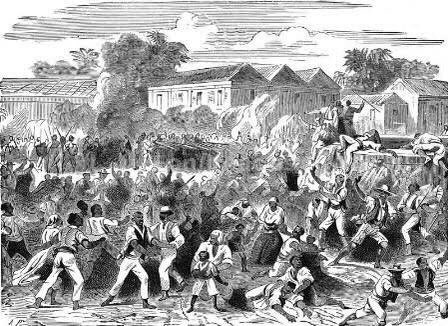
The dust of war had barely settled when strange hymns began to rise from the hills of Arochukwu. The same valleys that once echoed with war cries now trembled with songs of salvation. The Ibini Ukpabi Oracle was silent, its cave sealed, yet another kind of power was spreading not through fear, but through faith.
The written record
To the weary hearts of the people, the missionaries’ message of peace felt like rain on parched soil. But beneath the new faith, the old gods watched in silence, their stories whispering in the rustling leaves, asking “Will they remember us?”
Historical context
The Silence After the Storm
Mgbe ọkụ gwụrụ, àjà adịghị elu(When the fire goes out, the smoke no longer rises). The Aro Expedition of 1901–1902 left more than ruins, it left questions. With the oracle destroyed and the Aro confederacy dismantled, the spiritual backbone of the Igbo world seemed broken. Communities that once sought divine judgment at Arochukwu now faced foreign courts and foreign gods.
In the ashes of Ibini Ukpabi’s shrine, the British missionaries saw opportunity. They built churches near the very grounds where offerings once burned. The hymn replaced the chant, the cross replaced the ofo staff, and baptism replaced the oath. Yet, in every convert’s heart, the rhythm of the old faith still beat quietly and persistently.
From Oracles to Altars
The new faith spread fast. For the Igbo, who had long revered knowledge and morality, the teachings of the Bible felt both familiar and foreign. The God of the missionaries, Chineke, bore resemblance to Chukwu Okike Abiama the supreme creator they had always known by another name.
Many elders said, “Ọ bụ otu Chukwu, ndị ọzọ bụ ụzọ dị iche iche,” meaning “It is one God; only the paths differ.” Yet, as colonial schools grew and mission houses multiplied, the ancient paths began to fade.
The converts which includes the young, literate, and ambitious, formed a new generation that saw the world beyond the forest, beyond the spirits, beyond Arochukwu. Ọkpụkpụ mmadụ na-egbu mmadụ, ma ọ bụ okwu mmadụ ka na-egbu ya(It is not bones that kill a man, but words). It is ideas, not weapons, that change destinies.
The Rebirth of the Igbo Spirit
As decades passed, the Igbo became one of the most educated groups in West Africa. Mission schools in Arochukwu, Owerri, and Onitsha produced scholars, traders, and preachers who would lead Nigeria into modernity.
But even in their new faith, they carried echoes of the old. The same reverence for community, truth, and destiny that once guided the oracle now guided the pulpit. The old gods were not gone; they had simply changed their garments. In songs and proverbs, in masquerades and festivals, the Igbo soul found balance, blending tradition and transformation, ancestry and awakening.
Faith, Memory, and Identity
To be Igbo in the new century was to walk between two worlds, one of ancestors and one of angels. The oracle’s cave may have fallen silent, but in the people’s hearts, the same longing for justice and truth lived on.
Some say Ibini Ukpabi did not die; it was transformed, not into a god, but into a conscience that whispers in every Igbo soul(Remember where you come from). A na-amụta amamihe n’ala nna(Wisdom is born in the land of one’s fathers).
Today, when the church bells ring in Arochukwu, their echoes mingle with the hum of the forest. In that harmony lives the true story of the Igbo, a people who turned chains into crosses, and crosses into courage.
Sources and references
- Okoro, I. A. (2020). A critical study on the Ibini Ukpabi (Arochukwu Long Juju) Oracle and its implications on international relations during the 20th century. London Journal of Research in Humanities and Social Sciences, 20(10), 1–12.
- Kalu, O. U. (1978). Presbyterians and the Aro Expedition in The Nigerian Story. Ibadan: Daystar Press.
- Nwosu, I. E. (1992). Christianity and Cultural Renewal in Igboland. Nsukka: University of Nigeria Press.
Cite this article
Discussion
Sign in to join the discussion
Comments are checked by an editor before they appear. Leave a source or a correction and it is read first.
Continue reading
Related histories
 Anthropology and EthnographyThe Demography of Biafran Slave Exports (1650–1850)Read history →
 Anthropology and EthnographyMasquerade Traditions from Igboland to the Caribbean (Jonkonnu, Mocko Jumbie)Read history →
 Anthropology and EthnographyMapping Igbo Destinations in the Americas: A Comparative AnalysisRead history →
No comments yet
Nothing has been approved on this record yet. Comments are checked by an editor before they appear, so one written now shows on this page after that check.