 Ozikoro
 Anthropology and Ethnography · Published history
Igbo medicinal plants and traditional healing practices
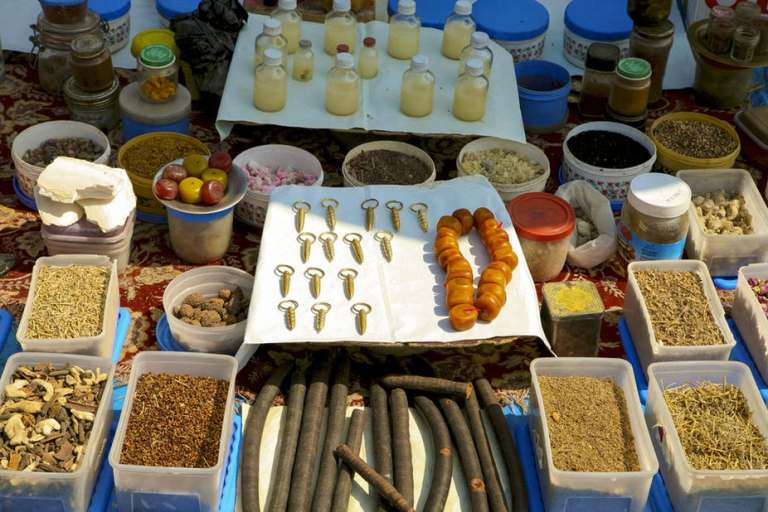
In the worldview of the Igbo people of Southeastern Nigeria, health is not merely the absence of disease but a state of “total harmony” between the individual, the community, and the spiritual cosmos. Traditional Igbo medicine, known as Ogwụ, is a sophisticated ethno-medical system that has evolved over millennia. It is built upon an intimate knowledge of the rich biodiversity of the rainforest and savannah belts, combined with a deep spiritual understanding of human psychology. Central to this system is the Dibia (traditional healer), who acts as a “botanist, physician, and priest.” While Western medicine has become the primary healthcare provider in urban centers, traditional Igbo medicinal plants and healing practices remain the “first line of defense” for millions, offering a holistic approach that treats the spirit and the body as an inseparable unit.
The written record
Historical context
The Dibia: The Guardian of Ancient Knowledge
The practice of Igbo medicine is anchored by the Dibia, a figure whose role is often misunderstood through a Western lens;
Specialization within the Craft: Not all Dibias are the same. There are the Dibia Ogwụ (specialists in herbalism and pharmacology), the Dibia Afa (diviners who diagnose spiritual causes of illness), and the Dibia Mgborogwụ (experts in root and bark medicine).
The “Call” to Heal: Becoming a Dibia is rarely a mere career choice; it is often described as a “spiritual calling” (Ichi Dibia). Apprenticeship is rigorous, lasting many years, during which the student must memorize thousands of plant species, their properties, and the “incantations” required to activate their potency.
Diagnosis through Divination: In Igbo healing, the first step is often Afa (divination). Before a leaf is plucked, the Dibia must determine if the ailment is natural/biological or if it has a “spiritual root” such as the breaking of a taboo or the interference of malevolent spirits.
Primary Igbo Medicinal Plants and Their Pharmacological Uses
The Igbo landscape is a “living pharmacy.” Many plants used in traditional settings have since been validated by modern phytochemical research;
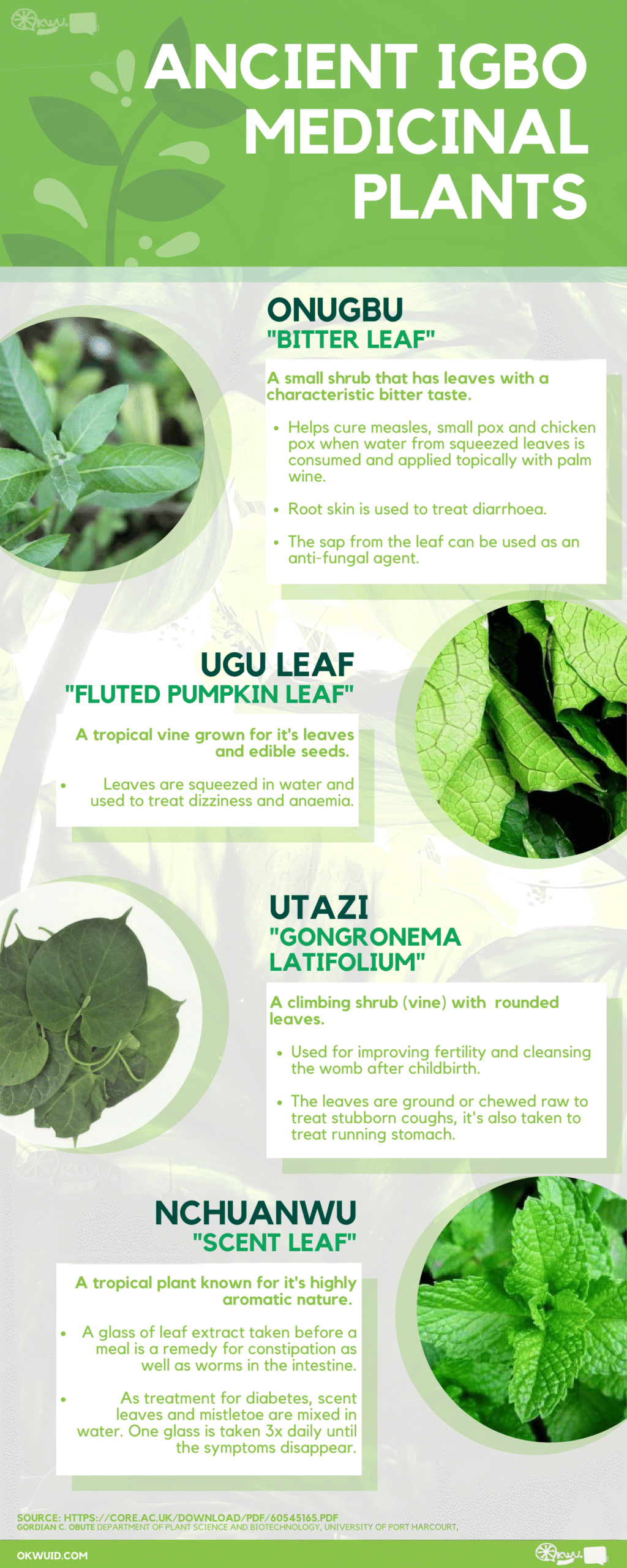
- Bitter Leaf (Akwụkwọ Ndụ – Vernonia amygdalina): Perhaps the most famous Igbo medicinal plant. It is used to treat “stomach upsets, malaria, and skin infections.” Modern studies have confirmed its “anti-diabetic and anti-cancer” properties.
- Scent Leaf (Nchuanwụ – Ocimum gratissimum): This aromatic herb is a staple in Igbo healing. It is used as an “antiseptic and anti-fungal” agent. Its steam is often inhaled to clear respiratory pathways, and the juice is used to treat diarrhea.
- African Basil and Utazi (Gongronema latifolium): Known for its sharp, bitter taste, Utazi is essential for “post-partum recovery” and as a digestive stimulant. It is often combined with other herbs to treat intestinal worms.
- Dogonyaro (Neem – Azadirachta indica): While not exclusively native, it has been integrated into Igbo practice as a “potent anti-malarial.” The leaves and bark are boiled into a tea (Agbo) that is a standard treatment for “yellow fever” and malaria.
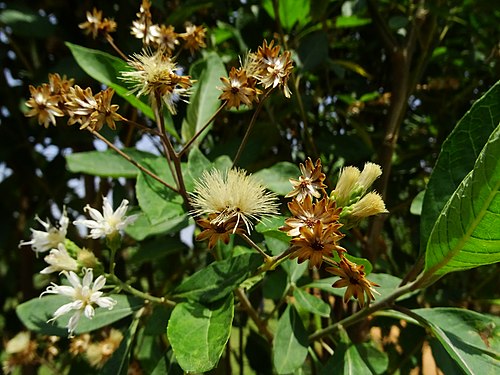
Photo Credit: International Institute of Tropical Agriculture (IITA) / Botanical Archive.
The Preparation and Administration of Ogwụ
Igbo medicine is characterized by specific “preparatory techniques” designed to extract the maximum life force from the plant;
Maceration: Some herbs are crushed or ground into a paste to be applied topically to wounds or fractures. In the case of “traditional bone setting,” the paste is applied to the broken limb before it is splinted with bamboo slats.
Scarification (Gbuo Gbuo): For localized pain or to introduce medicine directly into the bloodstream, a Dibia may make small incisions on the skin and rub in “charred herbal powders.”
Enemas (Utaba): Used primarily for pediatric care and digestive cleansing, herbal enemas are a common feature of Igbo domestic medicine, administered by mothers and grandmothers.
Spiritual Dimensions and the “Soul of the Plant”
In Igbo healing, a plant is not just a chemical container; it has a “spirit” (Muọ) that must be addressed for the cure to work;
- The Timing of Harvest: Certain medicinal plants must only be harvested at “dawn or midnight” to preserve their potency. The Dibia often speaks to the plant before cutting it, explaining the purpose for which it is being used.
- Sacrifice and Libation: In complex cases, the “administration of medicine” is accompanied by a sacrifice, usually a fowl or a kola nut to appease the deities or ancestors associated with the land where the herb grows.
- The Concept of Iche-Akwụkwọ: This is the belief that certain leaves lose their power if they “touch the ground” after being plucked. This meticulous handling reflects the “sanctity of the healing process.”
Challenges: Modernity, Standardization, and Conservation
Despite its resilience, traditional Igbo medicine faces significant “existential threats” in the 21st century;
- Deforestation: The rapid urbanization of Igboland and the clearing of “sacred forests” (Ohia Nso) have led to the extinction of rare medicinal species. The loss of the “forest laboratory” is a direct threat to the Dibia’s ability to practice.
- Lack of Documentation: Because Igbo medicine is largely an “oral tradition,” much knowledge is lost when a master Dibia dies without an apprentice. There is an urgent need for “systematic documentation” of Igbo ethnobotany.
- The “Quackery” Stigma: The lack of a formal “regulatory body” has allowed charlatans to operate under the guise of traditional healers, leading to skepticism among the Western-educated elite. However, organizations like the “Nigerian Natural Medicine Development Agency” are working to bridge this gap.
Igbo medicinal plants and traditional healing practices represent a “repository of human resilience and ecological wisdom.” This system has sustained the Igbo people through centuries of migration, war, and epidemic. The “bitter leaf” and the “scent leaf” are not just culinary ingredients; they are symbols of a “holistic science” that recognizes the profound connection between the earth and human health. As modern medicine continues to search for “new compounds” to fight drug-resistant diseases, the ancient “green books” of the Igbo Dibia offer a promising frontier. To preserve Igbo medicine is to preserve the “cultural and biological heritage” of the Niger Delta hinterland, ensuring that the “healing power of the forest” is not lost to future generations.
Sources and references
- Iwu, M. M. (1993). Handbook of African Medicinal Plants. CRC Press. (A comprehensive pharmacological study of Nigerian flora).
- Iwu, M. M. (1986). Empirical Basis of Traditional Medicine: The Case of the Igbo People. Journal of Ethnopharmacology.
- Sofowora, A. (1993). Medicinal Plants and Traditional Medicine in Africa. University of Ife Press.
- Umeh, J. A. (1999). After God is Dibia: Igbo Cosmology, Divination & Sacred Science. Karnak House.
Cite this article
Discussion
Sign in to join the discussion
Comments are checked by an editor before they appear. Leave a source or a correction and it is read first.
Continue reading
Related histories
 Anthropology and EthnographyThe Demography of Biafran Slave Exports (1650–1850)Read history →
 Anthropology and EthnographyMasquerade Traditions from Igboland to the Caribbean (Jonkonnu, Mocko Jumbie)Read history →
 Anthropology and EthnographyMapping Igbo Destinations in the Americas: A Comparative AnalysisRead history →
No comments yet
Nothing has been approved on this record yet. Comments are checked by an editor before they appear, so one written now shows on this page after that check.