 Ozikoro
 Anthropology and Ethnography · Published history
The Influence of Igbo Women in Language and Cultural Exchange: Insights from Colonial Anthropology
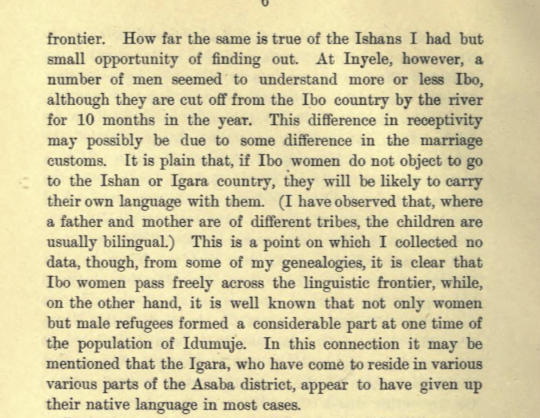
In his 1914 Anthropological Report on the Ibo-Speaking Peoples of Nigeria, British colonial anthropologist Northcote Thomas observed a fascinating dynamic in the Asaba District: Igbo women played a pivotal role in linguistic and cultural exchange across ethnic frontiers. He noted that while Igbo men showed little inclination to learn neighbouring languages like Igara or Ishan, Igbo women who married into non-Igbo communities often carried their language with them, fostering bilingualism in their children.
The written record
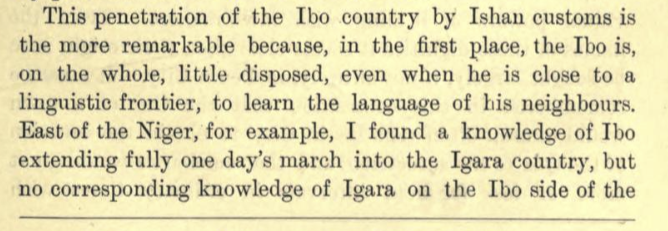
Thomas speculated that this phenomenon might explain why certain areas, such as Idumuje, had significant Igbo-speaking populations despite being outside traditional Igbo territory. He also documented cases where migrant communities, like the Igara in Asaba, abandoned their native tongues over time, possibly due to the influence of Igbo-speaking wives.
This pattern extends beyond Nigeria’s borders. The linguistic dominance of Igbo in places like Bonny—initially an Ibani-Ijo island—may owe much to Igbo women’s cultural transmission. Similarly, the prevalence of Igbo-derived vocabulary in Caribbean English creoles suggests that enslaved Igbo women disproportionately shaped these languages, possibly because they were more likely to teach their children Igbo while labor regimes isolated men.
Historical context
Even today, the legacy of Igbo maternal influence persists in Nigeria’s Delta region, where communities like the Kalabari and Andoni frequently intermarry with Igbo women from present-day Abia State, reinforcing cultural and linguistic ties. Thomas’s century-old notes thus hint at a broader truth: women, often overlooked in colonial ethnography, were key agents of language preservation and change.
Sources and references
- Northcote Thomas (1914). Anthropological Report on the Ibo-Speaking Peoples of Nigeria, Vol. IV: Law and Custom of the Ibo of the Asaba District, S. Nigeria , pp. 5–6.
Cite this article
Discussion
Sign in to join the discussion
Comments are checked by an editor before they appear. Leave a source or a correction and it is read first.
Continue reading
Related histories
 Anthropology and EthnographyThe Demography of Biafran Slave Exports (1650–1850)Read history →
 Anthropology and EthnographyMasquerade Traditions from Igboland to the Caribbean (Jonkonnu, Mocko Jumbie)Read history →
 Anthropology and EthnographyMapping Igbo Destinations in the Americas: A Comparative AnalysisRead history →
No comments yet
Nothing has been approved on this record yet. Comments are checked by an editor before they appear, so one written now shows on this page after that check.