 Ozikoro
 Anthropology and Ethnography · Published history
The Mischaracterization of Ekwensu in Igbo Cosmology
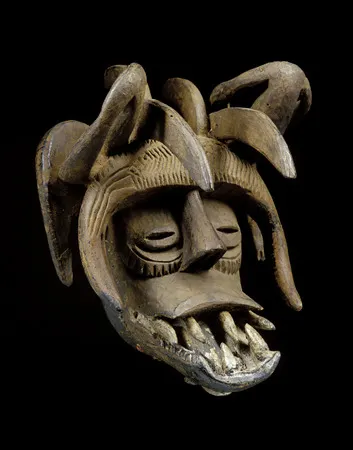
Among the various deities in Igbo cosmology, none has been as widely misinterpreted as Ekwensu. In many modern contexts especially through Christian missionary influence. Ekwensu has been portrayed as the “devil,” “Satan,” or embodiment of evil. However, this portrayal contradicts precolonial Igbo beliefs, oral histories, and ritual practices. Traditionally, Ekwensu represented negotiation, cunning intelligence, warfare, trade, and the unpredictable forces of human decision-making. The demonization of this deity reflects a broader pattern of colonial distortion of African spiritual systems.
The written record
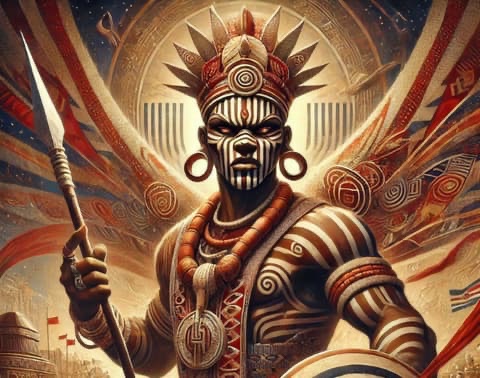
Ekwensu: The Igbo God of war.
Photo credit; Talkafricana.com.
Historical context
Ekwensu in Precolonial Igbo Cosmology
A Deity of Strategy and Negotiation;
Contrary to the colonial era interpretation of Ekwensu as evil, precolonial Igbo communities viewed Ekwensu as the deity of trade, negotiations, trickery, and war strategy. The Igbo understood life as a balance of forces, where even cunning and conflict had their necessary place. Ekwensu’s energy therefore represented the dynamic, calculating, and strategic aspects of human behavior rather than moral corruption.
Symbol of the Marketplace;
Ekwensu was associated with the ahia (market), a central institution in Igbo life. Traders prayed to Ekwensu for successful bargaining, competitive advantage, and persuasive skill. This aligns with the deity’s characterization as one who navigates unpredictable human interactions especially those involving negotiation, risk, and competition.
Patron of Warriors;
In some Igbo subcultures, Ekwensu was invoked by soldiers before battle. Not because the deity embodied violence for its own sake, but because Ekwensu symbolized courage, unpredictability, and strategic deception, all qualities necessary in warfare. Thus, the role of Ekwensu was complex, neither purely good nor inherently evil.
The Nature of Igbo Deities: Context, Balance, and Duality
To understand Ekwensu, one must appreciate the philosophical foundation of Igbo religion. Igbo cosmology does not divide the universe into absolute categories of “good” and “evil” in the Christian sense. Instead, it reflects complementarity and equilibrium, known as “ọfọ na ogu.” Deities embody natural forces and human tendencies, all of which have the potential for constructive or destructive expression depending on context.
Therefore, Ekwensu was not feared as a malevolent spirit but respected as a deity whose energy could be harnessed, appeased, or redirected when necessary.
Colonialism and the Demonization of Ekwensu
Christian Missionary Influence;
The mischaracterization of Ekwensu largely emerged during the 19th and early 20th centuries when Christian missionaries attempted to translate biblical concepts into local languages. Missionaries searching for an equivalent of the Christian “Satan” chose Ekwensu, likely because of the deity’s association with unpredictable human behavior. This translation, however, was a profound misinterpretation.
Missionaries presented African religions as primitive and demonic to justify Christian conversion. As a result, Ekwensu became the linguistic stand-in for ultimate evil, despite not fulfilling such a role in indigenous belief.
Colonial Suppression of Indigenous Practices;
Colonial-era writings, school curricula, and early Igbo-language Christian texts reinforced the misrepresentation of Ekwensu. For example, in the Igbo Bible, the word “Ekwensu” is consistently used to translate “devil,” which permanently shaped popular understanding.
This linguistic shift created a break between the precolonial meaning of Ekwensu and its postcolonial interpretation.
Consequences of misinterpretation
Cultural Alienation;
As Ekwensu became equated with evil, many Igbo people distanced themselves from indigenous spiritual systems. Sacred shrines were abandoned, and oral histories were suppressed or forgotten.
Loss of Historical Knowledge;
The original functions of Ekwensu as patron of traders, negotiators, and warriors were erased. Modern generations often know only the missionary interpretation, resulting in a significant distortion of Igbo cosmological understanding.
Distortion in Literature and Media;
Films, novels, and online platforms often perpetuate the colonial definition of Ekwensu, portraying the deity as a demon rather than a morally neutral force.
Anthropological Clarifications;
Recent scholarship emphasizes that Ekwensu was never the Igbo equivalent of Satan. Anthropologists such as Onwuejeogwu and Uchendu highlight that Igbo spirituality cannot be mapped onto Christian dualism. Instead, Ekwensu represents the human capacity to challenge, strategize, and negotiate.
Revival of Indigenous Knowledge;
With renewed interest in African traditional religions, many scholars and cultural practitioners are reclaiming the original meaning of Ekwensu. This involves documenting oral histories, identifying surviving shrines, and challenging missionary distortions.
Today, some Igbo thinkers argue that Ekwensu symbolizes the ambivalence and complexity inherent in human life, not an external source of evil. The deity’s capacity for creativity and disruption mirrors the Igbo worldview that all forces must be balanced, not moralized.
The mischaracterization of Ekwensu in Igbo cosmology stems largely from colonial and missionary efforts to translate Christian concepts into the Igbo religious framework. Precolonial Igbo beliefs reveal a deity far more nuanced: a force of negotiation, strategic intelligence, trade, warfare, and human unpredictability. Understanding this original meaning allows for a more accurate appreciation of Igbo cosmology and restores dignity to indigenous African knowledge systems. Reclaiming Ekwensu as a symbol of complexity rather than evil is crucial for correcting historical distortions and affirming the philosophical depth of Igbo traditional thought.
Sources and references
- Isichei, E. (1976). A History of the Igbo People. London: Macmillan.
- Metuh, E. I. (1985). African Religions in Western Conceptual Schemes: The Problem of Interpretation. Imico Press.
- Nwoga, D. I. (1984). Ekwensu and the Igbo worldview. Nsukka Journal of the Humanities, 3(2), 45–57.
- Onwuejeogwu, M. A. (1997). The Social Anthropology of African Traditional Religion. University of Nigeria Press.
- Uchendu, V. C. (2010). The Igbo of Southeast Nigeria. Holt, Rinehart and Winston.
Cite this article
Discussion
Sign in to join the discussion
Comments are checked by an editor before they appear. Leave a source or a correction and it is read first.
Continue reading
Related histories
 Anthropology and EthnographyThe Demography of Biafran Slave Exports (1650–1850)Read history →
 Anthropology and EthnographyMasquerade Traditions from Igboland to the Caribbean (Jonkonnu, Mocko Jumbie)Read history →
 Anthropology and EthnographyMapping Igbo Destinations in the Americas: A Comparative AnalysisRead history →
No comments yet
Nothing has been approved on this record yet. Comments are checked by an editor before they appear, so one written now shows on this page after that check.