 Ozikoro
Anthropology and Ethnography · Published history
The Power of the Female Gaze: Women’s Role in Kalabari Masquerade Performance
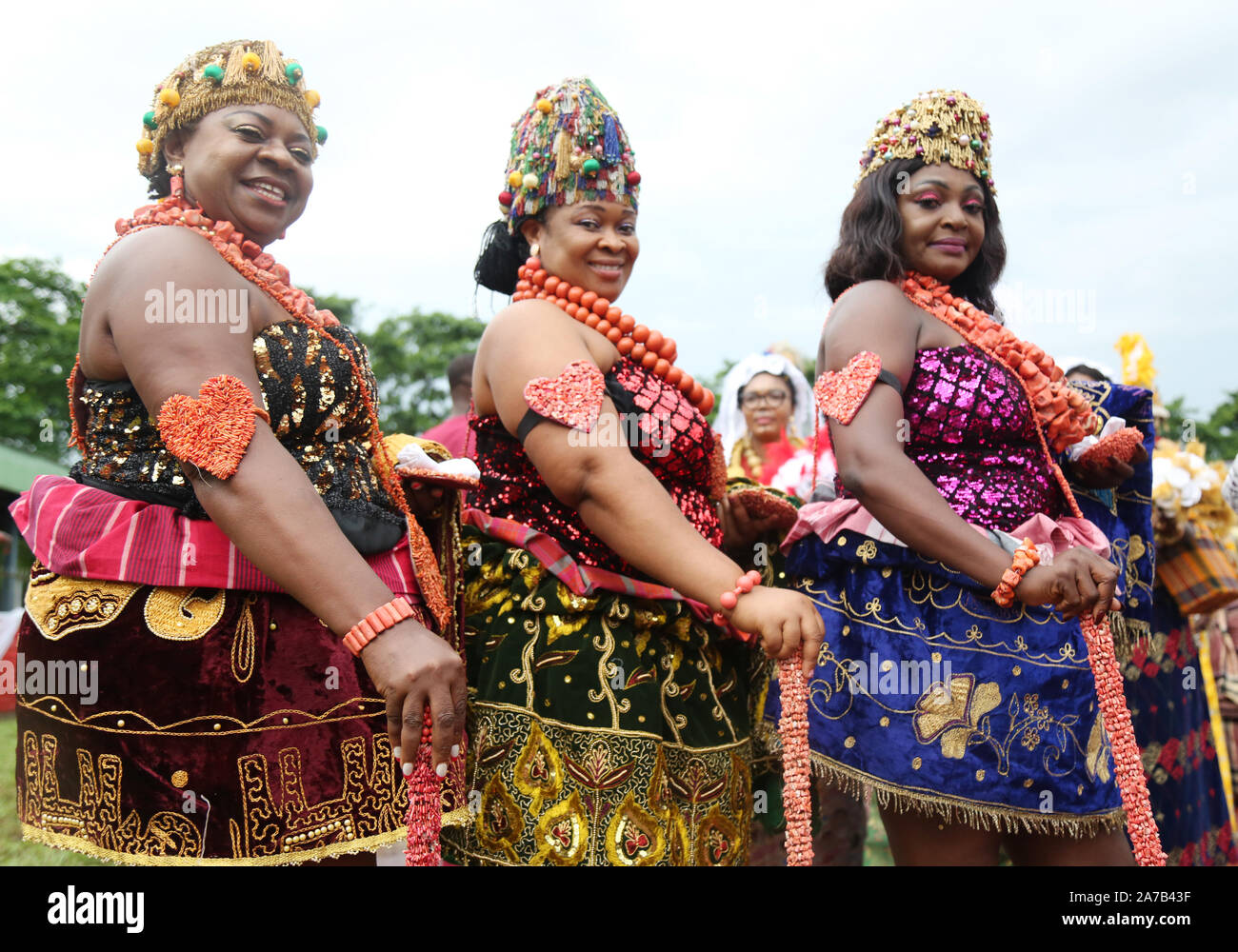
Masquerade traditions across the Niger Delta are often portrayed as exclusively male-controlled institutions, with strict rules prohibiting women from participating as performers. However, among the Kalabari people of Rivers State, the role of women in masquerade culture particularly in the Owu and other water-spirit masquerades, is far more nuanced. While men physically don the masks, women shape, interpret, sustain, and empower the masquerade through a culturally significant influence often described as the “female gaze.”
The written record
Photo credit: alamy.Historical context
Understanding Masquerade Culture in Kalabari Society
Kalabari masquerades represent ancestral forces, water spirits, and cultural identities. They appear during festivals, funerals, coronations, and rites of passage, serving both spiritual and social functions. Traditionally, men are responsible for the embodiment of the masquerade spirit, ritual preparation, and performance. However, focusing solely on this male role obscures the deeper gender dynamics that sustain the tradition.
Masquerades in Kalabari culture are communal creations, and the participation of women is essential at every level except the physical performance itself. Their involvement in song, costume design, ritual offerings, and interpretation reflects an interconnected system of gender cooperation rather than exclusion.
The Concept of the “Female Gaze” in Kalabari Performance
The term “female gaze” refers to women’s collective cultural power in shaping meaning, aesthetics, and reception within public performance spaces. In the Kalabari context, this gaze is not a mere act of watching; it is a form of social influence, evaluation, and sanction.
Women are considered the primary audience for many masquerades, especially Owu, the water spirit masquerade whose graceful movements are said to seek female admiration. The performers aim to impress women, who respond through song, praise, or critique.
This dynamic shapes the performance in three ways:
1. Aesthetic Validation: Women’s reactions determine whether a masquerade is “good,” “beautiful,” or spiritually potent.
2. Cultural Policing: The female gaze can reinforce or condemn inappropriate behavior by masquerades or performers.
3. Spiritual Legitimacy: Kalabari cosmology ties water spirits often depicted as feminine, to women’s intuitive, spiritual authority
Thus, the female gaze serves as both a social regulator and a spiritual validator.
Women as Custodians of Masquerade Songs and Oral Tradition
Masquerade performances rely heavily on music, praise-songs, and chants. Women are the primary custodians of these musical traditions. They compose the songs, teach them to younger generations, and lead the chorus during performances.
These songs serve vital functions:
Guiding the masquerade’s movement,
Invoking the presence of spirits,
Interpreting the masquerade’s gestures for the public,
Preserving history and communal memory.
Through music, women become the narrators of masquerade culture. Without their voices, the spiritual essence of masquerades, especially water-spirit masquerades cannot be fully activated.
Women as Costume Designers and Symbol Makers
While men craft the structural components of masks, women are deeply involved in creating and embellishing the costumes. Their expertise in dyeing fabrics, weaving, beadwork, and embroidery shapes the masquerade’s symbolic appearance.
Women’s design choices, colors, textures, patterns that represent encoded messages about: Spiritual attributes, historical memory, community identity and moral expectations.
As a result, the masquerade’s beauty is literally produced by feminine creativity. Men may wear the mask, but the visual language is crafted from a woman’s hand.
Contrary to stereotypes, Kalabari women perform crucial roles in the rituals surrounding masquerade performance. Their responsibilities include:
Providing ritual foods and offerings,
Preparing sacred spaces,
Leading invocation chants,
Conducting purification rites and
Welcoming water spirits with ceremonial songs.
Women’s spiritual authority is rooted in Kalabari cosmology, where water spirits (Owum) are often female or feminine in character. This association positions women as natural intermediaries, whose presence makes the ritual more potent.
In many Kalabari masquerade festivals, men openly acknowledge that they dance “for the women.” A masquerade praised by women gains fame, while one criticized loses prestige.
Women evaluate:
The skill of the dancer
The accuracy of the spirit’s portrayal
The beauty of the costume
The discipline and decorum of the ensemble
While their judgement influences:
The reputation of the performer,
The status of the masquerade house,
The social standing of the family sponsoring the masquerade.
Thus, the female gaze becomes a powerful cultural force shaping performance standards.
Although women cannot wear the mask, a prohibition rooted in ritual safety and spiritual taboo, they are not marginalised. Instead, their exclusion from direct performance elevates their symbolic power. The masquerade “dances for” women because they are the ultimate arbiters of beauty, spirituality, and social value.
This gendered power structure highlights two truths:
1. Men are the visible performers.
2. Women are the invisible authorities.
Together, they form a balanced cultural system where each gender’s contribution upholds the tradition.
The power of the female gaze in Kalabari masquerade performance reveals that women are indispensable to the tradition’s vitality. Through song, costume design, ritual involvement, spiritual interpretation, and cultural judgement, women shape the masquerade more profoundly than the masked dancers themselves. Their roles challenge the simplistic notion that masquerades are purely male domains. Instead, the Kalabari case demonstrates a complex gender partnership in which women contribute creativity, authority, and spiritual energy. Ultimately, the masquerade dances because women are watching and because women give it meaning.
Sources and references
- Alagoa, E. J. (2005). A history of the Niger Delta: An historical interpretation of Ijo oral tradition. Port Harcourt: Onyoma Research Publications.
- Horton, R. (1969). “From fishing village to city-state: A social history of the Niger Delta.” In M. Douglas (Ed.), The Dynamics of Clanship among the Tallensi. London: Routledge.
- Nabofa, M. Y. (1988). Symbolism in African traditional religion. Ibadan: Paperback Publishers.
- Oluwole, S. (2014). African indigenous cultures and religions. Lagos: Ark Publishers.
Cite this article
Discussion
Sign in to join the discussion
Comments are checked by an editor before they appear. Leave a source or a correction and it is read first.
Continue reading
Related histories
 Anthropology and EthnographyThe Demography of Biafran Slave Exports (1650–1850)Read history →
 Anthropology and EthnographyMasquerade Traditions from Igboland to the Caribbean (Jonkonnu, Mocko Jumbie)Read history →
 Anthropology and EthnographyMapping Igbo Destinations in the Americas: A Comparative AnalysisRead history →
No comments yet
Nothing has been approved on this record yet. Comments are checked by an editor before they appear, so one written now shows on this page after that check.