 Ozikoro
 Anthropology and Ethnography · Published history
Vanishing igbo children’s games and toys that taught survival skills , coordination and cultural values

In the traditional Igbo landscape of Southeastern Nigeria, childhood was not merely a period of biological growth but a rigorous “apprenticeship for life.” Long before the advent of digital screens and standardized western curricula, the Igbo child was educated through an intricate system of indigenous play. These vanishing Igbo children’s games and toys were more than idle entertainment; they were “pedagogical tools” designed to hone physical coordination, instill moral values, and impart essential survival skills within the tropical rainforest and savannah belts. Through these games, children learned the art of “negotiation, communalism, and strategic thinking.” As urbanization and globalization accelerate, these traditional pastimes are rapidly disappearing, taking with them a unique reservoir of “indigenous knowledge.” This article explores the structural and cultural dimensions of these vanishing games and the toys that served as the “first instruments of learning” for the Igbo child.
The written record
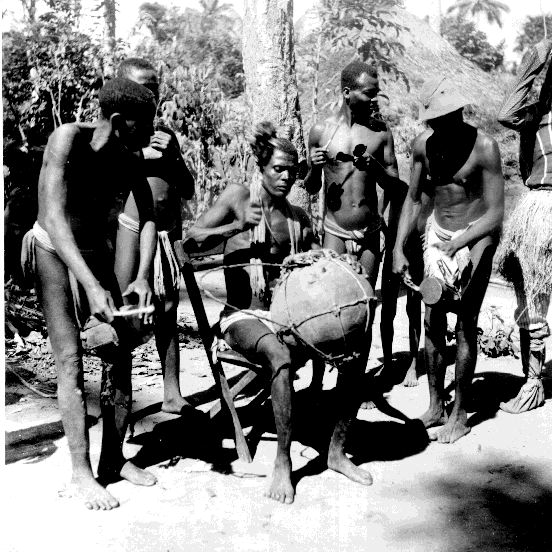
Band playing for Mmau Masquerade, Amuda village, Isu Ochi Instruments: udu (pot drum), two small membrane drums, on small ogene (iron bell) and a whistle. Photos credit : G.I. Jones
Historical context
Survival Skills: The Engineering of Traditional Toys
Traditional Igbo toys were rarely bought; they were “manufactured” by the children themselves from the local ecology, teaching them the fundamentals of engineering, material science, and survival;
- Kites and Aerodynamics: Constructed from thin “broomsticks and light paper or broad leaves,” kite-flying was a lesson in wind patterns and atmospheric conditions. A child had to learn how to “read the breeze” to keep their creation aloft, a skill essential for later life in weather-dependent agriculture.
- The Slingshot (Utaba or Agbaka): Crafted from a Y-shaped branch and elastic rubber, the slingshot was a child’s “first weapon.” While played as a game of target practice, it taught the “hand-eye coordination” required for hunting small game and birds, providing a rudimentary but vital survival skill for rural life.
Physical Coordination and Agility: The Athletics of Play
The physical games of the Igbo were designed to build a “resilient and agile body,” preparing the youth for the physical rigors of farming, climbing, and communal defense;
- Mgba (Traditional Wrestling): While formal wrestling was for adults, children engaged in “informal bouts” in the sand. This game taught “balance, leverage, and the ability to read an opponent’s movements.” It was the ultimate test of physical “fortitude” and was deeply tied to the concept of individual honor.
- Okoso (The Spinning Cone): Played with a cone-shaped seed or a carved wooden top, the objective was to spin the Okoso with a string and hit an opponent’s top. This game required “extraordinary manual dexterity” and an intuitive grasp of angular momentum. It was a game of “precision and high-stakes competition.”
- Ịgba Ọsọ and Hide-and-Seek (Oro): These games were played under the moonlight. Oro was particularly significant as it taught children how to “navigate the village geography” in the dark, move silently through the bush, and use camouflage skills that were historically necessary for “scouting and survival.”
Cultural Values: Play as a Moral Compass
Igbo games were the primary vehicles for “socialization,” teaching children the complex ethics of communal life and the “democratic spirit” of the people;
- Moonlight Tales and Games (Egwu Onwa): Gathered under the full moon, children played games that involved “rhythmical chanting and storytelling.” These games often ended with a moral lesson, reinforcing the “consequences of greed, laziness, and dishonesty.” It was here that the “oral tradition” was etched into the young mind.
- Kpo-Kpo-Kpo (The Counting Game): Often played in a circle, these games emphasized “communal rhythm.” If one child missed the beat, the whole group was affected. This taught the “interdependence of the community” the idea that the strength of the unit depends on the “harmony of its members.”
- Role-Playing (Egwuregwu Ezinụlọ): Children often mimicked the “adult world” by playing “house” or “market.” Boys would “mock-clear” the bush while girls would “mock-cook” with sand and leaves. This taught them their “gendered and social responsibilities” in a safe, experimental environment.
Strategic Thinking: The Intellectual Games
The Igbo value of “wit and cleverness” (amamịghe) was developed through games that required complex calculation and the ability to outsmart an opponent;
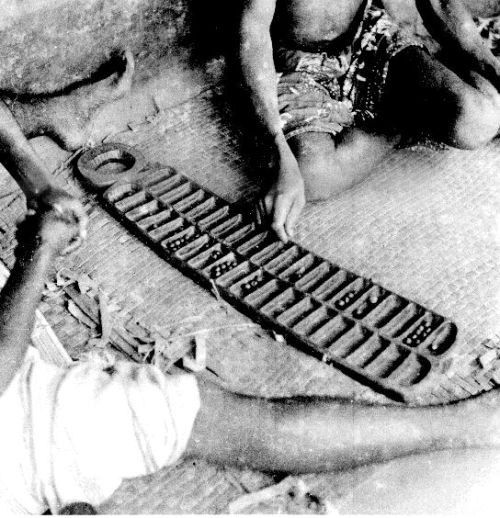
- Okwe (The Mancala Game): Often described as “the African game of strategy,” Okwe involves moving seeds across a wooden board with several pits. It is a game of “pure mathematics and foresight.” To win, a child had to calculate multiple moves ahead, teaching them “resource management” and “strategic planning” that would later apply to trade and village politics.
- Afa-Egwuregwu (Riddles): While not a physical game, the “exchange of riddles” was a competitive intellectual sport. It challenged children to think “metaphorically” and find connections between seemingly unrelated objects, honing the “sharpness of mind” required for Igbo oratory.
- Language Games: Using tongue twisters and secret “coded languages” (Igbo-Ilo), children learned the “nuances and poetry” of the Igbo language, ensuring that they became masters of communication.
The Vanishing Act: Modernity and the Loss of Play
The rapid decline of these games is not just a loss of “fun,” but a “cultural erosion” that impacts the developmental trajectory of the modern Igbo child;
- The Digital Displacement: Video games and television have replaced the “communal square.” Play has become an “individualized, sedentary activity,” leading to a decline in the “physical resilience” and “social intelligence” that traditional games fostered.
- Urbanization and Space: The “open fields and village squares” required for games like Mgba or Oro are disappearing in cities like Enugu or Onitsha. Without the “physical landscape,” the games have no room to breathe.
- Educational Standardism: The modern school system often overlooks “indigenous play” as a form of learning. The focus on “Western-style sports” (like football) has pushed traditional games like Okoso to the “margins of irrelevance.”
Vanishing Igbo children’s games and toys that taught survival skills, coordination, and cultural values were the “invisible classroom” of the ancestors. They produced individuals who were “physically tough, mentally sharp, and socially grounded.” To lose these games is to lose the “practical wisdom” of the Igbo people the ability to turn a palm frond into a bicycle or a seed into a strategic battle. There is an urgent need for “cultural documentation and revival,” perhaps by integrating these indigenous games into modern physical education curricula. As the world becomes increasingly digital, the “tactile, communal, and ecological” lessons of the Okoso and the Okwe are more valuable than ever. We must ensure that the “moonlight” does not set on these traditions, for in the “play of the child” lies the “strength of the nation.”
Sources and references
- Achebe, C. (1958). “Things Fall Apart”. London: Heinemann. (Providing context on the role of wrestling and moonlight storytelling in children’s lives).
- Aniakor, C. C. (1984). “Igbo Arts: Community and Cosmos”. Los Angeles: Museum of Cultural History, University of California. (Detailing the artistic and functional nature of traditional toys).
- Basden, G. T. (1921). “Among the Ibos of Nigeria”. London: Seeley, Service & Co. (An early ethnographic account of children’s games and socialization).
- Iwu, M. M. (1993). “Handbook of African Medicinal Plants”. CRC Press. (Referencing the plants used in creating traditional play items).
- Nzimiro, I. (1972). “Studies in Ibo Political Systems: Chieftaincy and Politics in Four Niger States”. University of California Press.
- Okafor, R. C. (2005). “Music and Musicians in Nigeria”. Enu gu: New Generation Books. (Discussing the role of rhythmic games and chants).
Cite this article
Discussion
Sign in to join the discussion
Comments are checked by an editor before they appear. Leave a source or a correction and it is read first.
Continue reading
Related histories
 Anthropology and EthnographyThe Demography of Biafran Slave Exports (1650–1850)Read history →
 Anthropology and EthnographyMasquerade Traditions from Igboland to the Caribbean (Jonkonnu, Mocko Jumbie)Read history →
 Anthropology and EthnographyMapping Igbo Destinations in the Americas: A Comparative AnalysisRead history →
No comments yet
Nothing has been approved on this record yet. Comments are checked by an editor before they appear, so one written now shows on this page after that check.